Showing posts with label Schoenberg. Show all posts

Friday, September 13, 2019

Schoenberg, Harmonielehre (1912/1922)

This continues and completes the series of posts tracing a line from Simon Sechter in the first half of the nineteenth century through his student Bruckner to Schenker and Schoenberg.

If Schenker took Sechter's ideas about scale degrees and chromaticism in one direction, expanding on them to reinterpret but also reinforce a traditional concept of harmony, Schoenberg went exactly the opposite direction from the same starting point. "In such matters as the existence of non-harmonic tones, the duration of harmonic steps and the notion of chords beyond the seventh, Schoenberg and Schenker could not be farther apart" (Wason 1982, 247).

Schoenberg's conversational, often satirical, style is on display in his chapter on the ninth chord, which begins
The 9th-chord is the stepchild of the system. Although it is at least as legitimate as the 7th-chord, it is still generally regarded as doubtful. It is hard to see why. The system begins to become artistic at the moment when it builds the minor triad in imitation of the major. Then, adding the seventh to form a 7th-chord, although not a necessary result of this first arrangement, is still a possible one. But if this is possible, then 9th-chords, 11th-chords, etc. are also possible, which would of course have the advantage that one could continue the system of extension by stacking thirds. (1922, 417; my translation)
He then spends some time poking fun at theorists' inconsistent treatment of inversions. That he accepts them is obvious from this passage near the end:
Of course, [inversions, such as the fourth inversion] no longer bother any serious people today. In [Strauss's] Salome quite a number of different 9-chords occur. . . . The student will easily find examples in the literature. There is no need to set special laws for [the 9th-chord's] treatment. Those who want to be careful can apply the laws that already came into play with the 7th-chords: that is, resolve the dissonance by step downward, make the root leap a fourth upwards. 
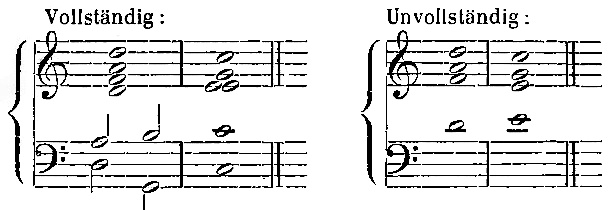
Finally, he says that altered forms of the ninth chord are "undeniably" useful as vagrant chords or in progressions involving vagrant chords, and he supplies this example:

Although this might suggest that even the dominant ninth chord type derives from the diatonic tonic ninth by alteration, in a previous example for ninth chords on secondary degrees, Schoenberg shows the dominant ninth chord first, then the others (including I9). In that respect, at least, he follows 19th-century theoretical tradition.

Reference
Arnold Schoenberg, Harmonielehre (1912/1922).   Source: Internet Archive; digital facsimile of a copy of unknown provenance.

Monday, September 9, 2019

Simon Sechter

Next I want to talk about Arnold Schoenberg's Harmonielehre (1912/ 3d ed. 1922), but I need to precede that with posts on Simon Sechter, Anton Bruckner, and Heinrich Schenker. The reason for this is a trail of influence: Sechter established what is sometimes called Viennese Fundamental Bass theory; he taught Bruckner, who became professor in the Vienna Conservatory (he also taught in the University of Vienna) and at one time or another both Schenker and Schoenberg were his students. On the latter two, Sechter's influence is still strong, despite their radically different goals and attitudes.

Sechter taught in the Vienna Conservatory during the first half of the century. He was a composer, organist, and teacher who published a three-volume theory/composition textbook near the end of his life. The first volume is on harmony; the others are on melody, rhythm/meter, and counterpoint. Robert Wason gives a nicely compact description of Sechter's treatment of the ninth chord:
Sechter introduces the ninth chord after the suspension (Grundsätze, pp. 30f), for it is always the result of the 9-8 suspension, not third stacking. No chords beyond the ninth are discussed in the Grundsätze, although Sechter has a habit of referring to the "suspensions of the eleventh and thirteenth." The 9-8 is shown resolving over a held bass on the dominant, as well as with change of bass to the tonic. "Concealment" of the fundamental enables Sechter to explain such apparent progressions as VII7-I, and delay of the resolution of the ninth beyond the change of bass is used to explain such apparent progressions as VII7-VI6. Sechter also introduces the ninth chord into the sequence. (1982, 78n16)
Unlike most others we have encountered so far, Sechter does not attempt an acoustical explanation, whether by supposition or by stacking thirds, but he then effectively derives the independent ninth chord from suspensions (rather than separating the acoustical/stacked-third entity from suspensions, as other authors do). His first example shows the suspension, with preparation:


The next example leads to the independent ninth chord (that is, one that resolves directly) by means of a "delayed resolution" (verzögerte Auflösung). Like his contemporaries, he is obviously of two minds about this chord: "to the ninth, which is introduced here arbitrarily and really only delays the entrance of the octave, one can attribute an (admittedly inauthentic) independence, in that one calls
simultaneous sounding of root, third, fifth, seventh and ninth a ninth chord" (Wason 1982, 138; Sechter, vol. 1, p. 30; in Müller's translation, p. 59).


As do most other authors, he allows the other diatonic ninth chords in suspension figures and sequences:


Remarkably, he allows the dominant ninth to engage with the interpolated root needed to explain root progressions by second:


As demonstration that Sechter can be said to admit the dominant ninth chord as an independent harmony, even if "unofficially," the examples below show that it may be used to prepare a 6-5 (or 6-5/4-3) resolution. Note also that he explains the viiø7 chord in the now familiar way as the ninth chord without its root. "Verschweigung" is Wason's "concealment"; the word literally means "silencing."


Sechter's commingling of abstract fundamentals with passing-chord figures will have far-reaching consequences in Schenker (and will be roundly rejected by Schoenberg). In the second example below, we can see again the typical uncertainty about the status of the ninth chord--if it looks independent in the earlier examples, now it is the result of passing tones.


Sechter's student Anton Bruckner "promoted the conservative theories of his mentor despite his own compositional innovations. He did, however, introduce several new ideas into Sechterian theory, most notably his treatment of the ninth chord, which he considered a fundamental harmony rather than the result of a suspension" (Bernstein 2002, 791). This is hardly surprising for the later 19th century, but Bruckner apparently differed from Sechter not only in this, but from his mentor and almost other textbook writers in that he largely ignored suspension figures (Wason, 138-39). If Schenker saw something suggestive in the linearity promoted by Sechter's abstract fundamental basses, Schoenberg might well have seen in the intense vertical emphasis the path to his own denial of non-chord tones.

Wason summarizes the differences between Sechter and Bruckner on the ninth chord:
In Sechter's system the ninth is always the product of suspension, there are no inversions of the ninth chord, and scale-degree ninth chords can only occur in the sequence through delayed resolution of a suspension beyond the change of bass. Moreover, the dissonances of the eleventh and thirteenth do not form chords. In Bruckner's system, on the other hand, the ninth chord is a "fundamental harmony”; the eleventh and thirteenth are on some occasions the result of suspension, while on others they are part of a six- or seven-note chord on the dominant.  (142-43)
Reference:
  • David W. Bernstein, "Nineteenth-century Harmonic Theory: The Austro-German Legacy," in The Cambridge History of Western Music Theory, ed. Thomas Christensen (2002), 778-811.
  • Arnold Schoenberg, Harmonielehre (1912/1922).   Source: Internet Archive; digital facsimile of a copy of unknown provenance.
  • Simon Sechter, tr. C. C. Müller, The Correct Order of Fundamental Harmonies: A Treatise of Fundamental Basses, and their Inversions and Substitutes (1871).   Source: Internet Archive; digital facsimile of a copy in the Brigham Young University Library.
  • Simon Sechter, Die richtige Folge der Grundharmonien, oder vom Fundamentalbass und dessen Umkehrungen und Stellvertretern (1853).   Source: Internet Archive; digital facsimile of a copy in the Wellesley College library.  
  • Simon Sechter, Die Grundsätze der musikalischen Komposition. Part 1: Die richtige Folge der Grundharmonien, oder vom Fundamentalbass und dessen Umkehrungen und Stellvertretern (1853). Part 2: (1854). Part 3: (1854). Source: Google Books; digital facsimile of a copy in the Harvard University library.
  • Robert W. Wason, Viennese Harmonic Theory from Albrechtsberger to Schenker and Schoenberg (1985). Reprint edition, 1995. Edited version of "Fundamental Bass Theory in Nineteenth Century Vienna," PhD diss., Yale University, 1981. I am using this last as source.

Thursday, September 5, 2019

Schoenberg in Hull, Modern Harmony

A. E. Hull reproduces the famous fourth inversion of the dominant ninth chord from Schoenberg's Verklärte Nacht (1897).

The example is Schoenberg's own, no. 267 (p. 418):

Hull mistakenly assumes that example 273, below, is from Halm, but it is actually Schoenberg's rewriting of Halm's Ex. 97 (for that, see the previous post). Recall that Halm's position on the ninth chord was somewhat more conservative than most textbooks in the second half of the 19th century: the dominant ninth chord is a proper harmony, but may only appear as V9 and only in root position. Schoenberg ridicules the inconsistent and un-argued assertions about inversions of the ninth chord in textbooks, especially the ban on the fourth inversion as "harsh" (or, as Halm does, banning them all). Schoenberg turns this around, saying that what was ugly yesterday may be considered beautiful today and noting that his sextet was rejected for performance but then was premiered two years later and nobody noticed that there was a fourth inversion ninth chord (1912/22, 418-419). He also refers to multiple instances in Richard Strauss's Salome.

Extended, detailed discussions of Verklärte Nacht may be found in Swift 1977 and Lewin 1987. Swift notes that the longer progression of which the dominant ninth is a part is "more than a linking passage, for it returns at two crucial structural points. First, it is the harmonic scaffolding for the recapitulation of the first group sentence (mm. 181-87), and is in part responsible for the ambiguity and uncertainty of that return. Second, this 'uncatalogued dissonance' returns in the first part of the coda as part of a succession of important motives from the composition" (10-11). Lewin's exceedingly detailed discussion weighs a variety of potential analyses and implied progressions. He focuses particularly though on the chord-pair together as occupying the functional space of a leading-tone diminished seventh chord, a hearing one can recognize if one expands the context to include the subsequent chords:


At the asterisks are two enharmonically equivalent diminished seventh chords (see Lewin 52-53, for the derivation of the first one, where the chord tone is the Ab3 and A-natural3 is understood as a passing tone). Ultimately he settles for the idea of the functionally ambiguous vagrant harmony, pointing simultaneously away from D minor (deceptive progression) and toward it (note the inverted chaconne-bass figure starting from i 6/4: A2-Bb2-B-nat2-C3-Db/C#3-D3).

Here is still another possibility. At (a) below is Schoenberg's Ex. 267b, the root position of the Ab major ninth chord. At (b) are typical textbook voicings of the first three inversions (I took these specific ones from Catel and Bussler). At (c) is Schoenberg's fourth inversion with a partial resolution into an augmented sixth chord in D minor; note that Ab is enharmonically G#. At (d), an alternative: the same augmented sixth chord in D minor with raised 3 and 5 (D becomes D#; F becomes F#) and a cadential close follows. This is consistent with Schoenberg's strict, even radical, notion of monotonality: all chromatic chords are alterations of diatonic ones (such that even what we now commonly regard as secondary or applied dominants are considered altered chords), and it is also consistent with Schoenberg's notion of vagrant chords, or chords with multiple potential harmonic meanings and therefore potential progressions (these are diminished seventh chords, augmented triads and their derivatives, and the augmented sixths; see 1912/22, 288 ff., especially 296 ff.).


Reference:

  • August Halm, Harmonielehre (1900).  Source: IMSLP; digital facsimile of a copy in the University of North Carolina Chapel Hill library.
  • Alexander Eaglefield Hull, Modern Harmony: Its Explanation and Application (1915).    Source: Internet Archive; digital facsimile of a copy in the University of Toronto Library. The Halm/Schoenberg example perhaps is a hint of the loose mode of quotation from sources that eventually fueled public complaints of plagiarism.
  • David Lewin, "On the 'ninth-chord in fourth inversion' from Verklärte Nacht," Journal of the Arnold Schoenberg Institute 10/1 (1987): 45-64.
  • Arnold Schoenberg, Harmonielehre (1912/1922).   Source: Internet Archive; digital facsimile of a copy of unknown provenance.
  • Richard Swift, ‘‘Tonal Relations in Schoenberg’s Verklärte Nacht,’’ 19th Century Music 1/1 (1977): 3-14.

Tuesday, September 3, 2019

A. E. Hull, Modern Harmony (1915)

Alexander Eaglefield Hull was a prolific writer, biographer, and encyclopedist on musical topics. His Modern Harmony: It Explanation and Application (1915) is atypical of his work in its focus on a technical subject, but its source must certainly lie in biographies of Scriabin and Cyril Scott that Hull was preparing at about that time (and published in 1916 and 1919, respectively).

Hull makes his advocacy of contemporary practices crystal clear at the outset:
The swift current of modern musical art during the past ten or fifteen years seems at first glance to have ruthlessly swept away the whole of the theories of the past. The earnest student may well be excused if he is bewildered completely on rising up fresh from his theoretical treatises to plunge into the music of actual life—of the twentieth-century opera houses, concert-halls, and music-rooms. . . .
      The whole of musical history . . . warns one against the too easy acceptance of the neatly turned epithets of persons who are . . . too indifferent to appreciate a new kind of music which claims at once wide sympathies and considerable powers of concentration. . . . Even on short acquaintance these modern musicians have too much method in their so-called “modernity” to be dismissed thus cursorily. It is the greatest possible mistake to view these modern schools as things separate from the art of the past. Indeed, most, of the new traits are legitimate growths out of the art technique of the acknowledged great masters. It does seem as if there were nothing new under the sun. As the principles of the twentieth-century Cubism in painting were well known some 400 years ago, so the modern methods of part-writing and chord-building all find their prototypes time after time in the pages of the great masters of the past.  (1-2; lightly edited)
Then Hull offers up a complaint frequently heard in the century or so from 1850 to 1950:
So much harmony teaching is founded on mere text-book formalities that there is little, if any, appeal to the evidence of the aural intelligence—the real arbiter in all matters of musical taste. It is the empirical method which makes the theory of the music of [recent] composers so difficult, and we cannot suppose that all of the explanations set down herein were present in the composers’ minds at the time of conception, or that they may even be acceptable always to the composers themselves. The system of teaching harmony by attaching names to the chords often produces an altogether false way of regarding music. No chord in itself conveys any meaning whatsoever. It can give a vague impression. . . , but thought in music can only be transmitted by chordal succession and forward movement, and the chord, however wonderfully arranged, has value only in this light. (4-5; emphasis in original)
Consistent with his approach—which simplifies discussion of harmony largely by removing complex labels—Hull has this to say about the dominant ninth and its inversions:
The unnecessarily forbidden appearance of the root in the inversions of the chord of the ninth tends to cramp part-writing, and the prohibition robs diatonic music of some of its most powerful effects. The root, which merely requires judicious placing and arrangement, may appear above the minor or major ninth with great effect. A wide selection of resolutions should be allowed.
For instance:
    (a) Both the major and minor ninth may fall a tone or semitone.
    (b) The ninth may remain.
    (c) The ninth may rise a chromatic semitone.
The case of (b) will be clearer still when the ninth is prepared, thus appearing as a pedal note. In all cases, so long as the ninth is satisfactorily resolved, the other notes are comparatively free. (18-19)
His example for (a)—see the arrow in the second bar—is from a song by Edward MacDowell, a piece so interesting in its treatment of the ninth that I will devote a separate post to it. For (b), see the beginning of the excerpt from the Verdi Requiem. For (c), look at the first chord pair from August Halm's Harmonielehrebuch [sic].


This last example is not in Halm's book. Hull is quoting from Schoenberg's Harmonielehre (1912), complete with the misspelling "Harmonielehrebuch" (properly it would be "Harmonie-Lehrbuch," although that isn't Halm's title, which is simply Harmonielehre).

Halm's example 97c is this. Schoenberg rewrites the progressions under (c). I will discuss his treatment of ninth chords in a separate post.


Halm's Ex 97c is actually meant as a negative example. He regards the V9 resolving to I (see his first examples under 97) as the only correct use of the ninth chord, in contradistinction to the dominant seventh, which he says has a much "softer" character and can move in almost any tonal direction. The two chord pairs under 97c show that one cannot reasonably apply the same traits to the ninth chord (Halm 1900, 118-119).

Reference:

  • August Halm, Harmonielehre (1900).  Source: IMSLP; digital facsimile of a copy in the University of North Carolina Chapel Hill library.
  • Alexander Eaglefield Hull, Modern Harmony: Its Explanation and Application (1915).    Source: Internet Archive; digital facsimile of a copy in the University of Toronto Library.
  • Arnold Schoenberg, Harmonielehre (1912/1922).        Source: Internet Archive; digital facsimile of a copy of unknown provenance.