Showing posts with label Sechter. Show all posts

Friday, September 13, 2019

Schoenberg, Harmonielehre (1912/1922)

This continues and completes the series of posts tracing a line from Simon Sechter in the first half of the nineteenth century through his student Bruckner to Schenker and Schoenberg.

If Schenker took Sechter's ideas about scale degrees and chromaticism in one direction, expanding on them to reinterpret but also reinforce a traditional concept of harmony, Schoenberg went exactly the opposite direction from the same starting point. "In such matters as the existence of non-harmonic tones, the duration of harmonic steps and the notion of chords beyond the seventh, Schoenberg and Schenker could not be farther apart" (Wason 1982, 247).

Schoenberg's conversational, often satirical, style is on display in his chapter on the ninth chord, which begins
The 9th-chord is the stepchild of the system. Although it is at least as legitimate as the 7th-chord, it is still generally regarded as doubtful. It is hard to see why. The system begins to become artistic at the moment when it builds the minor triad in imitation of the major. Then, adding the seventh to form a 7th-chord, although not a necessary result of this first arrangement, is still a possible one. But if this is possible, then 9th-chords, 11th-chords, etc. are also possible, which would of course have the advantage that one could continue the system of extension by stacking thirds. (1922, 417; my translation)
He then spends some time poking fun at theorists' inconsistent treatment of inversions. That he accepts them is obvious from this passage near the end:
Of course, [inversions, such as the fourth inversion] no longer bother any serious people today. In [Strauss's] Salome quite a number of different 9-chords occur. . . . The student will easily find examples in the literature. There is no need to set special laws for [the 9th-chord's] treatment. Those who want to be careful can apply the laws that already came into play with the 7th-chords: that is, resolve the dissonance by step downward, make the root leap a fourth upwards. 
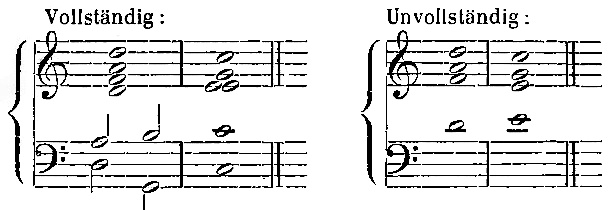
Finally, he says that altered forms of the ninth chord are "undeniably" useful as vagrant chords or in progressions involving vagrant chords, and he supplies this example:

Although this might suggest that even the dominant ninth chord type derives from the diatonic tonic ninth by alteration, in a previous example for ninth chords on secondary degrees, Schoenberg shows the dominant ninth chord first, then the others (including I9). In that respect, at least, he follows 19th-century theoretical tradition.

Reference
Arnold Schoenberg, Harmonielehre (1912/1922).   Source: Internet Archive; digital facsimile of a copy of unknown provenance.

Wednesday, September 11, 2019

Heinrich Schenker, Harmonielehre (1906)

This continues from the previous post. I am tracing the line of influence from Sechter through Bruckner to Schenker and Schoenberg. As Wason summarizes the difference between these latter two, "if Schenker's Harmonielehre was written to build a 'bridge from composition to theory,' Schoenberg's was an attempt to build a bridge from Viennese Fundamental Bass theory to the new
music of the early twentieth century" (Wason 1982, 235). By 'bridge from composition to theory,' Schenker means that he intends his book to be comprehensive, neither merely speculative (or scientific) nor merely a series of mechanical exercises (Wason, 230).

The book, therefore, is in the traditional two parts: theoretical and practical. In the theoretical part, there are two divisions: systems (major, minor, modes) and intervals and harmonies. Under harmonies, there are three sections: three-note chords, four-note chords, and five- and more-note chords. These last are labeled "angeblich" (supposed or alleged). Nevertheless, Schenker gives sixteen pages to the dominant ninth chord and ten to the others.

He first criticizes the textbooks that allow a dominant ninth chord on the basis of stacked thirds but then restrict or forbid inversions. He then rejects the ninth chord as an independent harmony. In effect, it is a chimera, an accidental result of substitution (Vertretung). The three diatonic chords V, V7, and viiø7 share the diminished fifth ^7-^4 and therefore can substitute for one another (why the triadic vii° is missing is not clear) (1906, 249-251). He says that the space of the ninth these three chords share has deceived some into thinking that they can create a ninth chord from it (251; "Nun hat offenbar der Raum der None aber, innerhalb dessen die Vertretung der (verwandten) eindeutigen Akkorde sich abspielt, die täuschende Wirkung ausgeübt, dass man darauf verfiel, die Erscheinung unbewußt als eine Nonenakkordbildung zu kreieren"). This, of course, is no more an argument than those that reject inversions because they are "harsh"—it just offers us a different sort of statement of rejection of the ninth than we have seen in earlier authors.

Thus, although Schenker is said to have derived some of his system from Bruckner, his attitude toward the ninth chord is definitely more conservative, indeed is rather more negative even than Sechter's.

Schenker's repertoire examples—from Mozart, Chopin, and Wagner—are all about the minor dominant ninth, and so they are of less interest to us here. I will reproduce just one of them as a sample:


Reference:
  • Heinrich Schenker, Harmonielehre (1906).    Source:  IMSLP; digital facsimile of a copy of unknown provenance. I did not have the Mann Borgese translation available at time of writing.
  • Arnold Schoenberg, Harmonielehre (1912/3rd ed. 1922).   Source: Internet Archive; digital facsimile of a copy of unknown provenance.
  • Simon Sechter, tr. C. C. Müller, The Correct Order of Fundamental Harmonies: A Treatise of Fundamental Basses, and their Inversions and Substitutes (1871).   Source: Internet Archive; digital facsimile of a copy in the Brigham Young University Library.
  • Simon Sechter, Die richtige Folge der Grundharmonien, oder vom Fundamentalbass und dessen Umkehrungen und Stellvertretern (1853).   Source: Internet Archive; digital facsimile of a copy in the Wellesley College library.  
  • Simon Sechter, Die Grundsätze der musikalischen Komposition. Part 1: Die richtige Folge der Grundharmonien, oder vom Fundamentalbass und dessen Umkehrungen und Stellvertretern (1853). Part 2: (1854). Part 3: (1854). Source: Google Books; digital facsimile of a copy in the Harvard University library.
  • Robert W. Wason, Viennese Harmonic Theory from Albrechtsberger to Schenker and Schoenberg (1985). Reprint edition, 1995. Edited version of "Fundamental Bass Theory in Nineteenth Century Vienna," PhD diss., Yale University, 1981. I am using this last as a source because it is readily accessible to me.

Monday, September 9, 2019

Simon Sechter

Next I want to talk about Arnold Schoenberg's Harmonielehre (1912/ 3d ed. 1922), but I need to precede that with posts on Simon Sechter, Anton Bruckner, and Heinrich Schenker. The reason for this is a trail of influence: Sechter established what is sometimes called Viennese Fundamental Bass theory; he taught Bruckner, who became professor in the Vienna Conservatory (he also taught in the University of Vienna) and at one time or another both Schenker and Schoenberg were his students. On the latter two, Sechter's influence is still strong, despite their radically different goals and attitudes.

Sechter taught in the Vienna Conservatory during the first half of the century. He was a composer, organist, and teacher who published a three-volume theory/composition textbook near the end of his life. The first volume is on harmony; the others are on melody, rhythm/meter, and counterpoint. Robert Wason gives a nicely compact description of Sechter's treatment of the ninth chord:
Sechter introduces the ninth chord after the suspension (Grundsätze, pp. 30f), for it is always the result of the 9-8 suspension, not third stacking. No chords beyond the ninth are discussed in the Grundsätze, although Sechter has a habit of referring to the "suspensions of the eleventh and thirteenth." The 9-8 is shown resolving over a held bass on the dominant, as well as with change of bass to the tonic. "Concealment" of the fundamental enables Sechter to explain such apparent progressions as VII7-I, and delay of the resolution of the ninth beyond the change of bass is used to explain such apparent progressions as VII7-VI6. Sechter also introduces the ninth chord into the sequence. (1982, 78n16)
Unlike most others we have encountered so far, Sechter does not attempt an acoustical explanation, whether by supposition or by stacking thirds, but he then effectively derives the independent ninth chord from suspensions (rather than separating the acoustical/stacked-third entity from suspensions, as other authors do). His first example shows the suspension, with preparation:


The next example leads to the independent ninth chord (that is, one that resolves directly) by means of a "delayed resolution" (verzögerte Auflösung). Like his contemporaries, he is obviously of two minds about this chord: "to the ninth, which is introduced here arbitrarily and really only delays the entrance of the octave, one can attribute an (admittedly inauthentic) independence, in that one calls
simultaneous sounding of root, third, fifth, seventh and ninth a ninth chord" (Wason 1982, 138; Sechter, vol. 1, p. 30; in Müller's translation, p. 59).


As do most other authors, he allows the other diatonic ninth chords in suspension figures and sequences:


Remarkably, he allows the dominant ninth to engage with the interpolated root needed to explain root progressions by second:


As demonstration that Sechter can be said to admit the dominant ninth chord as an independent harmony, even if "unofficially," the examples below show that it may be used to prepare a 6-5 (or 6-5/4-3) resolution. Note also that he explains the viiø7 chord in the now familiar way as the ninth chord without its root. "Verschweigung" is Wason's "concealment"; the word literally means "silencing."


Sechter's commingling of abstract fundamentals with passing-chord figures will have far-reaching consequences in Schenker (and will be roundly rejected by Schoenberg). In the second example below, we can see again the typical uncertainty about the status of the ninth chord--if it looks independent in the earlier examples, now it is the result of passing tones.


Sechter's student Anton Bruckner "promoted the conservative theories of his mentor despite his own compositional innovations. He did, however, introduce several new ideas into Sechterian theory, most notably his treatment of the ninth chord, which he considered a fundamental harmony rather than the result of a suspension" (Bernstein 2002, 791). This is hardly surprising for the later 19th century, but Bruckner apparently differed from Sechter not only in this, but from his mentor and almost other textbook writers in that he largely ignored suspension figures (Wason, 138-39). If Schenker saw something suggestive in the linearity promoted by Sechter's abstract fundamental basses, Schoenberg might well have seen in the intense vertical emphasis the path to his own denial of non-chord tones.

Wason summarizes the differences between Sechter and Bruckner on the ninth chord:
In Sechter's system the ninth is always the product of suspension, there are no inversions of the ninth chord, and scale-degree ninth chords can only occur in the sequence through delayed resolution of a suspension beyond the change of bass. Moreover, the dissonances of the eleventh and thirteenth do not form chords. In Bruckner's system, on the other hand, the ninth chord is a "fundamental harmony”; the eleventh and thirteenth are on some occasions the result of suspension, while on others they are part of a six- or seven-note chord on the dominant.  (142-43)
Reference:
  • David W. Bernstein, "Nineteenth-century Harmonic Theory: The Austro-German Legacy," in The Cambridge History of Western Music Theory, ed. Thomas Christensen (2002), 778-811.
  • Arnold Schoenberg, Harmonielehre (1912/1922).   Source: Internet Archive; digital facsimile of a copy of unknown provenance.
  • Simon Sechter, tr. C. C. Müller, The Correct Order of Fundamental Harmonies: A Treatise of Fundamental Basses, and their Inversions and Substitutes (1871).   Source: Internet Archive; digital facsimile of a copy in the Brigham Young University Library.
  • Simon Sechter, Die richtige Folge der Grundharmonien, oder vom Fundamentalbass und dessen Umkehrungen und Stellvertretern (1853).   Source: Internet Archive; digital facsimile of a copy in the Wellesley College library.  
  • Simon Sechter, Die Grundsätze der musikalischen Komposition. Part 1: Die richtige Folge der Grundharmonien, oder vom Fundamentalbass und dessen Umkehrungen und Stellvertretern (1853). Part 2: (1854). Part 3: (1854). Source: Google Books; digital facsimile of a copy in the Harvard University library.
  • Robert W. Wason, Viennese Harmonic Theory from Albrechtsberger to Schenker and Schoenberg (1985). Reprint edition, 1995. Edited version of "Fundamental Bass Theory in Nineteenth Century Vienna," PhD diss., Yale University, 1981. I am using this last as source.

Monday, January 7, 2019

Simon Sechter

Simon Sechter, organist, composer, teacher, and music theorist in Vienna (link), is best known now for his harmony treatise, Die Grundsätze der musikalischen Komposition (3 vols., 1853: link to Internet Archive copy). Earlier, he published a Praktische Generalbass-Schule, Op.49 (1830; link to copy on IMSLP).

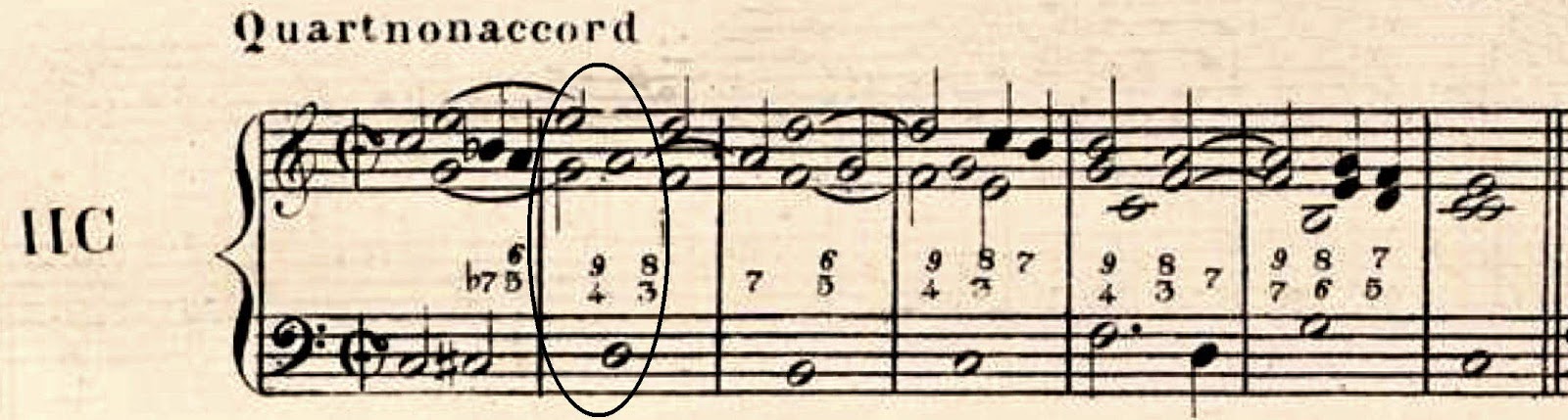
The treatise on figured bass is very traditional. Its focus is on the inventory of figures, how to recognize and organize them in the mind, and to learn to play the associated chords. As such, the concern with ninths is with that figure, not any specific inventory of harmonies. For instance, his first example of the "Nonaccord" is for a 9-8 suspension of a simple tonic triad--circled below.


The next is for 9-8 above seventh chords of different qualities. The one circled is a minor minor seventh chord, ii7 in C major. The dominant with major ninth appears in bars 2 and 5 (not circled).


And here is a double suspension, 9-8 with 4-3, the underlying chord being a D minor triad. Notice that Sechter throws in a dominant ninth in the cadence, further evidence that he is concerned with the figure 9, not specific chord groups.


The final example shifts away from suspensions to passing tones/chords.


For the most part, the pedagogy of theory and composition throughout the nineteenth century recognized ninth chords as vertical entities but assigned them to suspension or passing chord figures. Suspensions, to be sure, were an important part of the evolution of the independent dominant ninth harmony, but so were the varieties of incomplete neighbors (especially—but not exclusively—appoggiaturas).