Showing posts with label pedagogy. Show all posts

Tuesday, June 6, 2023

Textbooks, update, part 6

My last post added to the series on traditional harmony textbooks (link to first post) discussion of a modern harmony text from the 1950s. Vincent Persichetti doesn't have anything negative to say specifically about the dominant major-ninth chord, but as I wrote, he "greatly favors other seventh and ninth chord types over the dominant major-ninth, which does appear in a reference example of the same kind of sequential progression that we saw in Mitchell and Ottman, but only once in the chapter's nine composed examples."

Just a few years earlier, Paul Hindemith indirectly offered an explanation: the dominant major-ninth harmony (like its close cousin the half-diminished seventh) was too strongly associated with 19th century music. Hindemith was a student in the years before WWI, and matured as a musician and composer in the years immediately following, when the aesthetics and practices of the earlier era, especially anything Wagnerian, were soundly rejected. Thus there is a definite sarcasm in his proposing composition exercises for the harmonium, that "primitive wheezebox": "Is not treasuring such a pitiful instrument like preaching the virtue of poverty and the moral value of asceticism to one living in luxury? The counter-question might be: Why not, if that will further the development of the individual and the general welfare?" (Traditional Harmony, vol. 2, 31, 32) In other words, the argument is a bit like that for writing species counterpoint. . . .

In his conclusion, it's obvious that Hindemith is referring to the dominant major-ninth, the ø7, and various altered dominants: 

In respect to harmony and tonality, our pieces will inevitably sound like so many hundreds of the sentimental genre pieces of the post-Tristan style. . . . What was originally felt to be so 'modern' and to promise so much, turns out to be a technical device that is useful only for the creation of all too limited effects. Nevertheless, it is advisable once, for practice, to wallow thoroughly in this style of writing if only to learn through exaggeration what in the end one wants to avoid.

Like Persichetti's harmony, Leon Dallin's Techniques of Twentieth Century Composition was a very influential text in the 1960s and 1970s (edition I looked at: Techniques of Twentieth Century Composition: A Guide to the Material of Modern Music, 3rd ed., 1974). Dallin makes the same point as Hindemith but very explicitly and with prejudice against "popular" music styles:
Major and minor ninths can be added to all of the seventh chord structures, both diatonic and altered. The dominant ninth was the first to be incorporated into the harmonic vocabulary, but its value to serious composers is impaired by popular connotations and triteness. The sounds of other less hackneyed ninth chord forms are still capable of pungent expressiveness, even to jaded twentieth-century ears, when used with imagination.

Ouch. Still, for the era, and for professional concert and college-based composers, Dallin was undoubtedly right. In a recent essay, I wrote that musicians working in the popular styles he denigrates were equally reticent: the statistics show that the dominant major-ninth harmony appears surprisingly infrequently in songs from the 1920s through the 1980s (at least in the songs' published form; performances and arrangements may well differ). Link to Dominant Ninth Harmonies in Music from 1900 to 1925, Part 4.

Monday, May 22, 2023

Textbooks, update, part 5 (Persichetti)

 I have added Vincent Persichetti's classic Twentieth Century Harmony: Creative Aspects and Practice to this series of posts, first, because it is in a traditional textbook format and uses a traditional sequence, despite the very different material being discussed, and, second, because it is a good representative (still cited today) of mid-20th century attitudes toward harmony and harmony pedagogy among then-practicing North American and European composers. 

Like other texts that tackled complex harmony beginning already in the early 20th century, Twentieth Century Harmony also stands in the awkward position of prescribing harmonic solutions at a time when harmonic function was quickly losing its hegemonic force. Persichetti's claim isn't small: The book is "a detailed study of the essential harmonic technique of the twentieth century,  presented according to the practice of contemporary composers. This text aims to define this harmonic activity and make it available to the student and young composer."

The magnitude of the problem--and of Persichetti's optimism--is apparent in the opening of chapter 1:

Any tone can succeed any other tone, any tone can sound simultaneously with any other tone or tones, and any group of tones can be followed by any other group of tones, just as any degree of tension or nuance can occur in any medium under any kind of stress or duration. Successful projection will depend upon the contextual and formal conditions that prevail, and upon the skill and the soul of the composer.

It's hard to know what to expect of ninth chords, given those assertions. But under the circumstances, the general statement seems straightforward enough, though it certainly requires the information and examples that follow to be saved from vagueness and to offer any kind of practical instruction:

The seventh and ninth members of chords are traditionally dissonant tones but they have been freed of some of their former restrictions. These chords have become stable entities in themselves with their dissonant tones not necessarily prepared or resolved. Seventh and ninth chords, like triads, may progress within or outside any scale formation, original or traditional. Under certain formal conditions the seventh and ninth are treated as dissonant tones needing resolution; but as independent seventh and ninth chords they have the facility of triads.

A problem common to related literature is the definition of chords. Ninth chords have five members and can be considered complex. As we saw with Sessions, inversions can introduce considerable ambiguity about chordal identity. Persichetti says fourth inversions are used freely, and one example offers an opening chord of A2-G3-F4-B4 as G9. I have trouble hearing this as anything other than Am9, despite the "extraneous" F4. (Hindemith, btw, would agree with Persichetti, as the strongest interval by his calculation is the third G-B.) 

Much the same with non-harmonic notes. Here is the beginning of one example with my annotations:


It is almost impossible to avoid the "reduction to simpler sonorities" priority in cases like these, even if as here those are seventh chords rather than triads.

Finally, after all this, there isn't much to say that connects to the topic of this blog, because--as the example above hints--Persichetti greatly favors other seventh and ninth chord types over the dominant major-ninth, which does appear in a reference example of the same kind of sequential progression that we saw in Mitchell and Ottman, but only once in the chapter's nine composed examples.

Saturday, May 20, 2023

Textbooks, update, part 4

Ratner

Chapter 11 of Harmony: Structure and Style is on dominant sevenths and the tonic 6/4. Chapter 12 is titled "VII7 and V9--The Major Sixth in Dominant Harmony"; it ends with a helpful summary. Here that is, with further quotes and my comments:

1. The major sixth in dominant harmony appears in two chords, the V9 and the VII7.  [Note that Ratner uses the non-distinctive capital letters of scale-step theory. Since he is writing only about the major key at this point in the book, we know that VII7 is the same as viiø7.]

2. The sixth degree adds a strong characteristic element of color to dominant harmony.  [He is referring mainly to later 18th century music, where the supporting harmony is viiø7: his first two examples are from Mozart and Beethoven. But a brief excerpt from Brahms, Symphony no. 1, II, has a V9 in first inversion--see below--though in typical Brahmsian fashion it sounds as much like an accented neighbor chord as an independent ninth chord.]


3. Usually, the sixth degree appears in the uppermost voice, since it possesses marked melodic value.  [In the main text he says ^6 is best in the top voice "where its melodic tendency will be realized in a salient manner."]

4. The sixth will tend to resolve downward to the fifth degree, before the dominant harmony moves to tonic or at the change of harmony. [This "tending to resolve downward" comes from the idea of ^6 as a neighbor to ^5. His options cover my internal and direct resolution categories, respectively.]

5. The sixth may leap downward to another tone of the dominant harmony in a chordal melodic figure, relieving the sixth of the need to be resolved directly.  [His point about this in main text, though, is that ^6 makes a very effective "melodic apex," after which comes a fall to the cadence or other resolution.]

6. In a 6-7-8 pattern the sixth moves upward to the leading tone, and the V9 is first struck without a leading tone.  ["Occasionally, when one voice moves 6-7-8, the harmony momentarily becomes V9 with 6 supplanting the leading tone at first. The musical effect of this can be quite poised and elegant, as shown below."]

7. V° and VII' are usually used within a phrase, except in cases described in summary points 5 and 6.

Sessions

Of all the books surveyed in this series of posts, Session's Harmonic Practice shows the most obvious evidence of an experienced and practically- minded composer. "Frozen" accessory tones are of two types: "Ninth, Eleventh, and Thirteenth Chords" and "Substitute Functions." He offers no method of derivation, just says the ninth chord is "generally classified as a basic chord type," later adds "so-called" to first mention of elevenths and thirteenths, and ends the section with the statement that "in the overwhelming majority of cases, these chords are used on the dominant degree, but use on other degrees is also possible."

The ninth can be resolved internally because the root is already present (he shows both V9 and I9) and thus the ninth can be left by leap internally, but the same cannot be said of the seventh.

As to inversions, they "are extremely varied in harmonic effect, even in the case of different positions of the same inversion, which . . . if they are played in alternation seem to denote a genuine change in harmony." Here is the second inversion of C: V9.

Sessions closes with "For these reasons, it seems better to consider the ninth as an accessory note which habitual usage has 'frozen' onto the chord." Quite sensible from an historical perspective, though he omits to say the same is true of the dominant seventh chord and the add6.

Thursday, May 18, 2023

Textbooks, update, part 3

Harder/Steinke

In Harmonic Materials in Tonal Music, Pt. II, 6th ed., the three extended chords are grouped together, and the model of superimposed thirds is assumed. The historical summary I might have written myself: "Used sparingly by earlier composers, ninth, eleventh, and thirteenth chords occur more frequently toward the end of the 19th century. They are especially characteristic of Impressionistic music." The chords may be built on any scale degree, "but the majority are dominant chords."

The chords are definitely regarded as harmonies, but the authors acknowledge that "since these tones often appear as non-harmonic devices, it is sometimes difficult to decide whether they should be interpreted as members of the harmony or as incidental melodic occurrences." Given this quite reasonable statement it seems odd that they do not offer more repertoire examples--there is none with a direct resolution.

Hindemith

The laconic style of Traditional Harmony, vol. 1, was quite deliberate: the volume is really a set of exercises with notes for reference, not a narrative or expository presentation. Hindemith ignores third-stacking except for the dominant ninth chord. He does not mention 11ths, and the 13th originates from substitution; he says "dominant seventh chord with sixth"--which replaces the fifth--but figures the 6 as 13. He allows first and third inversions of the ninth chord, not the second or fourth (implicitly--he just doesn't mention them). Finally, he says that "in progressions, the two derivations [9th and 13th] and their inversions are treated like V7 and its corresponding inversions." The exercises maximize spelling opportunities and as such don't really reflect characteristic practices in existing compositional genres.

Ottman

In Advanced Harmony: Theory and Practice, 4th ed., ch. 10 is divided into three topical units: (1) "chords of the ninth," (2) "eleventh and thirteenth chords," and (3) exercises in "writing ninth chords" plus "the ninth chord in the harmonic sequence."

After an introduction, the sub-sections in the first unit are (1) "ninth chords in which the ninth resolves before a change of root," (2) "ninth chords in which the ninth resolves simultaneously with the chord change," (3) "ninth chords in which the ninth and seventh are arpeggiated," (4) "irregular resolution of the ninth," (5) "ninth chords in sequence." Third stacking is used, and non-dominant ninth chords are accepted but are only "occasionally seen."

Of the ten textbooks discussed in this series, Advanced Harmony has the best arrangement of well-defined sections coordinated with multiple repertoire examples.

Sub-sections 1 and 2 align with my "internal resolution" and "direct resolution" of the major dominant ninth chord. After noting that most internal resolutions can be regarded as melodic figures over V7, Ottman does observe that "When the ninth is held or repeated, a stronger feeling for an independent ninth chord may result. . . . As emphasis on the ninth increases, analysis as a ninth chord becomes more likely, but in any case, the decision is a subjective one at best." This aligns with my emphasis on a melodic-to-harmonic continuum in my "seven types" (link).

Sub-section 3: Here is the reference example with my annotations.

The one example in sub-section 4 is an upward resolution of the ninth, which should be very familiar to readers of this blog and my essays published on Texas ScholarWorks (see the index here: link). Sub-section 5 consists of a reference example showing alternating seventh and ninth chords in a sequential passage--the same progression from Mitchell's Elementary Harmony that I reproduced in the previous post.

Piston/Devoto

In Harmony, 5th ed., chs. 22 & 23 are on seventh chords other than the dominant seventh. Ch. 22 is short, more of a footnote to the preceding: it's on the "incomplete major ninth"--that is, to say the half-diminished seventh or viiø7. The idea that this chord may be added to below--"subtended"--goes back to Rameau and appears in many 19th century texts and treatises. 

Ch. 24, then, takes up the ninth chord proper, which of course is called the "complete dominant ninth."

The author(s) isolate "three important aspects" of the chord:

1. "The ninth may appear as a non-harmonic tone, resolving downward into the fifth degree [my internal resolution], or sometimes, if it is the major ninth, up to the seventh degree [my ascending figure], before the chord itself resolves. It is often an appoggiatura, in which case the harmonic color is very pronounced." 

2. "The ninth may be used in a true harmonic sense as a chord tone but it may be absent from the chord at the moment of change. This is an important aspect of harmonic treatment of the ninth in common practice. It actually consists of the resolution by arpeggiation of a dissonant factor, a principle applied to no other dissonant chord (it is also called dissolution by some theorists). . . ." Ottman's 9-to-7 arpeggiation--see the musical example earlier in this post--is one instance of this.

3. "Finally, the ninth may act as a normal dissonant chord tone resolving to a tone of the following chord."  This is my external or direct resolution.

The major dominant ninth has further limitations; it represents a harmonic color characteristic of the end of the common-practice period rather than the eighteenth century. Employed as in the third of the aspects just described, it is rarely encountered until the latter part of the nineteenth century. We will meet the dominant major ninth again in Part Two of this book in connection with impressionistic harmony, in which it is of great importance both as an independent, quasi-consonant sonority and as an adjunct to the triad in modal harmony.

Here is their particularly clear presentation of inversions, with my annotations. The fourth inversion (with ninth in the bass) is rejected.


Tuesday, May 16, 2023

Textbooks, update, part 2

Forte (none); Laitz (none)

Of the ten textbooks I browsed during a recent visit to a college library, two don't mention ninth chords. These are Allen Forte, Tonal Harmony in Concept and Practice, 2d ed.; Steven Laitz, The Complete Musician, 2d ed. In Forte's case, the reason is clear: his pedagogy is based closely on Schenkerian theory, a conservative (in 2023, one might better say reactionary) model of harmony in which everything is reducible to triads and their linear elaborations. I don't know Laitz's reason--I am relying only on the table of contents and the index, where extended chords including ninths don't appear. It's possible he may say something in the preface or elsewhere.

Gauldin

Ch. 31 of Harmonic Practice in Tonal Music is 11 pages, of which 4 are given to the dominant ninth and just a half page to non-dominant ninths. He does give some space at the end of the chapter to added 6ths and 9ths, which is a positive point.

Gauldin uses a simple "extended tertian harmonies" model. The 9th in the dominant chord, whether major or minor, "became a bona fide member of the V chord" in the later 18th century, which is fair if we mean V(b9) but overstates the case if we mean V9 as an independent chord. The same is true of the claim that "by the middle of the 19th century, composers were using prolonged dominant ninths quite frequently" -- he then quotes the inevitable Franck Violin Sonata (1886) as well as the Prologue to Act I of Götterdämmerung (prod. 1876). European and European-influenced musicians working in all styles were indeed using dominant ninths by this time, but "quite frequently" misrepresents the statistics if by "frequently" one means "commonly" or "often." And "prolonged dominant ninths quite frequently. . ." is simply not the case: "expressive" and "prominent," perhaps, but "not often" if we take the repertoire as a whole before the 1880s. Finally, we note that he doesn't mention inversions.

Early on, Gauldin asserts that "we will regard [the] added thirds as dissonances and treat them as suspension or neighboring figures, much like the chordal 7th in seventh chords." Later examples do have chord labels for V9 but show voice leading figures above. I would read these as direct resolutions: V9 goes to I. Saying that these independent V9s "have their [historical] source in suspension or neighboring figures" would be adequate to clarify the situation.

Mitchell

In Elementary Harmony, 3rd ed., ch. 15 is 30 pages long, the topic being seventh chords, after which 10 pages are given to ninth chords in ch. 16. Eleventh and thirteenth chords are not mentioned. The final chapters are on applied/secondary dominants (17) and modulation (18).

Mitchell distinguishes between "simple" and "manipulated," which correspond to my "internal resolution" and "direct resolution." (For definition and examples, see my early post on the 7 types of the dominant major-ninth: link.) Despite the seemingly derogatory "manipulated," Mitchell regards the V9 in direct resolution as a distinct harmonic entity. Later he strengthens the point by calling internal resolutions "pseudo ninth chords." He does, however, return to a "descending natural succession" to describe the origin of the major dominant ninth chord.

He rejects all non-dominant ninth chords out of hand: "they remain details of horizontal motion"--a bit extreme perhaps but still a reasonable description of most music before the 1890s. He says of inversions, "chances are that [they are] the result of simple figuration," but in a later paragraph he rejects them as "fiction" and "alleged." 

Mitchell was also under Schenkerian influence, and we can be thankful that he did recognize the independent ninth chord, even if it still suffers the stigma of being "manipulated."

Sunday, May 14, 2023

Ninth chords in harmony textbooks: an update

 Recently I was able to visit a university music library, where I looked at the presentation of ninth chords in the following textbooks. They are not current editions (those are on reserve for students in pedagogy courses), but I have good reason to suspect that these are representative, in other words that little has changed in the pertinent chapters.

Allen Forte, Tonal Harmony in Concept and Practice, 2d ed. (1974; 1st ed. was 1962)
Robert Gauldin, Harmonic Practice in Tonal Music. (1997)
Paul Harder/Greg Steinke, Harmonic Materials in Tonal Music, Pt. II, 6th ed. (1990)
Paul Hindemith, Traditional Harmony, vol. 1 (1944)
Steven Laitz, The Complete Musician, 2d ed. (2008)
William Mitchell, Elementary Harmony, 3rd ed. (1965)
Robert Ottman, Advanced Harmony: Theory and Practice, 4th ed. (1992)
Walter Piston/Revised and Expanded by Mark Devoto, Harmony, 5th ed. (1987)
Leonard Ratner, Harmony: Structure and Style (1962)
Roger Sessions, Harmonic Practice (1951)

In earlier posts, I wrote about historical textbooks, mostly 19th century, beginning in January 2019: link. The only post-1950 textbook I looked at was the 8th edition of a music score anthology by Benjamin, Horwitz, Koozin, and Nelson: link.

Of the ten books discussed here, five put the ninth chord in the usual, relatively brief chapter late in the volume: Gauldin, ch. 31; Harder/Steinke, ch. 11 (final); Mitchell, ch. 16 out of 18; Ottman, ch. 11 in book 2 of the sequence; Piston/Devoto, ch. 24 out of 31. Forte doesn't mention it at all, not surprising given his Schenkerian loyalties. Laitz doesn't, either. Hindemith, on the other hand, puts the ninth and the thirteenth in chapter 6 (out of 16 total), immediately after inversions of the dominant seventh. Ratner has the same placement, in ch. 12 out of 27, as does Sessions: 9th chords are in §5 of ch. 7 "Accessory Tones"--ch. 6 introduced seventh chords.

Here are repertoire lists for the eight volumes (excluding Forte and Laitz). As a reminder, only items with the major dominant ninth are included.

Gauldin

Kuhlau, Sonatina, op. 20, no. 1, II
Franck, Violin Sonata, I
Wagner, Götterdämmerung, Prologue to Act I
Wagner, Götterdämmerung, Act I

Harder/Steinke

Fauré, "Après un Rêve"
Debussy, Pelléas et Mélisande, Act II, scene 1

Hindemith: only his newly written exercises

Mitchell

Schubert, waltz, op. 50, no. 18
Schubert, waltz, op. 9, no. 34
Beethoven, Quartet, op. 18, no. 6, IV
Schumann, op. 99, no. 11, trio
Schubert, waltz, op. 9, no. 30

Ottman

Verdi, Il Trovatore, Act IV, no. 19
Grieg, In der Heimat
Tchaikovsky, The Nutcracker, Overture
Chopin, Nocturne, op. 72, no. 1
Wagner, Götterdämmerung, Act III
Dvorak, Quartet, op. 105, III

Piston/Devoto

J. S. Bach, WTC II, Fugue in D major
Schubert, Mass no. 6 in Eb, Kyrie
Wagner, Rheingold, scene 2
Haydn, [Piano] Sonata no. 7, II
Chopin, Nocturne, op. 72, no. 1
Mussorgsky, Songs and Dances of Death, no. 3
Franck, Symphony, I
Verdi, Requiem, Requiem
Schumann, Symphony, no. 2, III
Franck, Piano Quintet, I

Ratner

Mozart, Sonata, K. 576, I
Schubert, Fantasia, op. 78
Chopin, Preludes, op. 28, no. 21

Sessions: only reference examples, no repertoire

In the next post, I will begin description and commentary for each book in turn.

Sunday, July 31, 2022

Extending downward: A curiosity

The usual method of extending triads to make 7, 9, 11, and 13 chords is to go above. (And I point out yet once more that's a theoretical and pedagogical convenience, not a historical narrative.) But we can also play with going the opposite direction. Here's an example, where (at a) the top note remains the same (just like the root would do if we were building upward) and the bass moves down by thirds. At (b) I've isolated the fifth movements that get us to Db#11.

This generates a surprisingly large percentage of basic chord types--and also a good sounding progression! 

Tuesday, March 8, 2022

Harmony at the Ninth: The repertoire problem

 In a previous post, I outlined a harmony pedagogy that would place the ninth chord near the beginning of the curriculum, not—as is typically the case (if it's taught at all)—somewhere near the end. I also noted that my plan got into trouble at the point of choosing repertoire. I'll discuss the three main reasons here: (1) repertoire bias in the traditional theory core curriculum; (2) conflict between 18th/19th century and 20th/21st century theoretical models; (3) difficulty in finding entirely diatonic examples suitable for first-year theory classroom use.

To begin, I have assembled and posted to my Google Drive a list of all the musical examples for the five essays on the dominant ninth chord that I have published on the Texas ScholarWorks platform to date: 

The essays are named at the beginning of the file, and abstracts and links are provided.

(1) repertoire bias in the traditional theory core curriculum

The historical narrative for classical music that prevailed through much of the 20th century was progressive, that is, it began from one point (usually medieval chant) and led by more or less regular steps forward into contemporary music. So, we have the first inklings of counterpoint around 1000 AD, eventually a perfected polyphony in the 16th century, an organized major/minor tonal system thanks to continuo practice and pedagogy in the later 17th and early 18th centuries, and a gradual expansion or break-down of that system through more complex harmonic relations and increased chromaticism in the 19th century, till we reached a fully chromatic model epitomized by twelve-tone and serial music. Despite this scheme, the heart of the story remained with the High Classical period (sometimes called the First Viennese School) with Haydn, Mozart, and Beethoven.

This is the narrative I learned as a young student. We had only just begun to acknowledge some of its problems even by the time I started college in 1968. For my purposes here, though, and beyond noting that these repertoire biases have barely changed in mainstream college introductory theory textbooks, the one point that is immediately relevant can be easily understood by a quick comparison of the repertoire list linked above with two textbook-based lists. The smaller of the two is derived from Kostka & Payne, 3rd ed. (even earlier than my 4th ed. copy!): David Temperley corpus study: see the bottom of that web page. The larger is the table of contents for the score anthology by Benjamin, Horvit, Koozin, and Nelson, Music for Analysis, 8th edition (2018).

Temperley extracts the 46 longest examples from the Kostka & Payne workbook. Of these, 29 are by Haydn, Mozart, Beethoven, and Schubert. For these 29, 11 are from piano sonatas, 3 from other pieces for piano, 9 from chamber music, 2 from concertos, 3 songs, and 1 opera.

Benjamin, Horvit, Koozin, and Nelson has 477 examples ranging from the 17th century to the present. Of these, 378 are prior to 1900, with 175 by Haydn, Mozart, Beethoven, and Schubert. For the 378, 49 are from piano sonatas, 12 from other pieces for piano, 32 from chamber music, 2 from concertos, 15 songs and vocal ensemble music, and 5 operas. In addition, 24 are dances in keyboard format, and 37 are from orchestral ensemble music (symphonies and overtures).

For reference, in Benjamin, Horvit, Koozin, and Nelson there are two examples from Johann Strauss, jr., while in Temperley's extracts from Kostka & Payne there are none—which points up the problem: there is very little intersection between their lists and mine, in which Johann Strauss, jr. and sr. dominate. Some important caveats: Apart from the Strausses, my study of the major dominant ninth chord is skewed toward the decades surrounding 1900. As I have noted in essays, I have generally looked at shorter compositions; for longer works, I use keyboard reductions rather than full scores but I haven't focused on large instrumental ensemble music and have done even less with chamber music. I have studied dances—especially polkas and waltzes—throughout the 19th century, not just Schubert dances. The historical circumstance that ascending cadence gestures, upper-register cadences, and clear treatment of the major dominant ninth all seem to have arisen in music for dance led me to the larger repertoires that incorporated them, beginning with opéra comique in the 1830s, then blossoming in operetta in the 1850s and later. In general, composers—including Schubert himself—would be more conservative when writing in the larger instrumental forms than in the popular forms of dance music and music for the stage. In another post I will report on my look at the Allegretto grazioso quasi Andantino in Brahms's Symphony no. 2 and at his Waltzes, op. 39. Even in the midst of the Schubert craze of the 1860s—to which he also contributed—Brahms was a genius at suggesting but avoiding the two characteristic chords of scale degree ^6: the dominant ninth and the add6.

(2) conflict between 18th/19th century and 20th century theoretical models

Textbooks still lump the “extended chords” together, in a model of progressive stacked thirds, even if, as Kostka & Payne remark in their 4th ed.: "Just as superimposed 3rds produce triads and seventh chords, continuation of that process yields ninth, eleventh, and thirteenth chords (which is not to say that this is the manner in which these sonorities evolved historically)." (!!) Jazz theory, on the other hand, doesn't bother with that, because the harmonic vocabulary is based on the dominant seventh with a variety of sounds, "tensions," and alterations built on it. In Mark Levine's Jazz Theory Book (1995), for example, "extensions" (9th, 11th, 13th) are listed in the glossary, but the ninth chord is never explicitly introduced in the text. Instead, it simply appears in the first example for the II-V-I progression:


This version of the opening of "Stella by Starlight" is a concise catalogue of the three main 9th chord types, but note that none of Levine's chord labels (above the score; mine are below in blue) indicates a 9.

Here are some additional examples drawn from different places in The Jazz Theory Book. My labels are below the score. The 9 is included in the fourth chord only because it is altered (G-nat = Fx).


(* I am grateful to UT-Austin doctoral alum and friend Joel Love for telling me about Levine's book. Link: His web page.)

(3) difficulty in finding entirely diatonic examples suitable for first-year theory classroom use

My first examples would, of course, come from Schubert waltzes, but it turned out to be difficult to find simple examples of V9 without also including chromatic chords. Here is the second strain of Valses nobles, D. 969, n11 (1828), with its "textbook perfect" V9 with a direct resolution. Bars 5-6 would require some discussion, however.


In their section on the dominant ninth, Benjamin, Horvit, Koozin, and Nelson include Strauss's Künstlerleben, one of the best known of his mid-period waltzes. I don't know what they say about it, as I don't have a copy of the anthology, but I can say that I find the choice of no. 3 particularly good because the ninth appears several times in different roles, and the only chromatic consideration is a relatively simple cadence to V at the halfway point. At (a) and (c) are internal resolutions (9 resolves within V). At (b) and (d) are "almost direct" resolutions (9 is held over the first part of I); the example below the score shows what a direct resolution would have been in (b). At (e) is the upward resolution of 9 that facilitates an ascending cadence. And at (f1) & (f2) is a very common device that flips the functional status of scale degrees ^7 & ^6: at (f1) ^7 is a simple chord tone and ^6 forms the ninth, but at (f2) ^7 is an appoggiatura and ^6 is a simple chord tone.


Simplified, correct, but not as expressive version of bars 6-8:


The question of repertoire choices appropriate for different levels can be explored through the repertoire list mentioned and linked to at the top of this post. I can add here that I have studied but have not yet reported on stage works from opéras comiques of the 1830s (mainly Adam, Auber) to operetta (Offenbach, Lecocq, Strauss), Savoy opera (Sullivan), and American operetta (Herbert) and musical (Kern). And of course there is something still to be said about that "genius of avoidance," Brahms.

Sunday, March 6, 2022

Harmony at the Ninth

In the past year or two, a movement toward curriculum change in college-level music theory ("reform" is the word more often used) has rapidly accelerated. Research had already expanded notably into new repertoires, especially music of all styles in the late 20th and 21st centuries. The journal demonstrating this most strongly is Music Theory Online (link), a longstanding internet-based and peer-reviewed journal of the Society for Music Theory, and one can also see the effects on teaching in recent volumes of the Journal of Music Theory Pedagogy (link). Other major journals are beginning to follow their lead.

Reading recently about one group's proposal to remove or severely limit the use of chorale harmonizations (almost always those by J. S. Bach), I decided to experiment with another change. What if large-market music theory textbooks took the dominant ninth chord out of its late-chapter ghetto and put it at or near the beginning of the book instead? 

I'll use the 8th edition of Kostka, Payne, and Almén, Tonal Harmony with an Introduction to Post-Tonal Music (2017; publisher link) as my representative example. The book has 28 chapters. The topics covered are: in the first four, fundamentals; in the next eleven, diatonic triads and seventh chords; in the following ten, chromaticism; and in the final three, post-tonal theory. The second section on chromaticism encompasses chapters 21-25: 21 & 22 introduce the usual Neapolitan chord and augmented sixths, which are already found in 17th century sources and become staples of expressive harmonic practices in the 18th century; 23 is on enharmonic spellings; 24 is titled "further elements of the harmonic vocabulary"; and 25 carries us through the late 19th century.

I am now switching editions because the publisher's link for the 8th edition, which I do not own, does not show chapter subheadings. Some time ago I purchased a copy of the 4th edition (2004) for $1.00 at our local Half-Price Books Outlet store. A comparison of the tables of contents for the 4th and 8th editions suggests little has changed overall. The "further elements" chapter has five sections, the first two being on altered dominants. In the third section we finally reach "ninth, eleventh, and thirteenth chords." There are five musical examples, two from Beethoven, two from Schumann, and one the inevitable Franck Violin Sonata opening. Only the latter shows the major dominant ninth; three are Vb9, and one is ii9.

From less than four pages at the back of the book to a place of honor at or near the beginning of the curriculum would seem an impossible task, but actually I found it easy--but only up to a point. The difficulty was repertoire examples. I'll report on that in a subsequent post.

To begin: I assume that the student has covered fundamentals, including clefs (at least treble and bass), note names, intervals, scales (at least major and minor), and spelling triads and seventh chords. Knowing something about Roman numeral chord labels and jazz/popular chord symbols would be helpful, though they could be taught in conjunction with the text here.

Here are the four types of triads: major, minor, diminished, and augmented. The first three can be found in the major scale. The first line of labels is from jazz/popular-music theory; since labels can vary quite a bit, I chose to use the ones on the Berklee College of Music page Glossary of Terms (link) under “Terms Used in Harmony [1-4].” The second line has labels associated with guitar chord symbols.


The third line has Roman numeral labels, the type most commonly used in traditional undergraduate harmony textbooks. An alternate version you’ll sometimes see doesn’t have distinctions of “chord quality” (that is, major, minor, diminished, augmented) but just capital letters, so for the first three in the graphic I, II, VII. This system has trouble with accidentals so there’s no easy label for the last one, and in general this “all-caps” scheme is less useful than the others, and worse, although it does simplify things, it forces one into accepting a model where everything else is a variant of the scale-based triad.

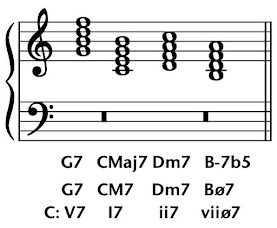
Seventh chords add a scale note a third above the triad. The major triads produce two very different types. The first one  is the “major-minor seventh chord” (major triad plus a minor third) or “dominant seventh” or “V7” or just “seventh chord” or “7”—in most music of the last century when you say “seventh chord” this one is the default. Notice that the label in the graphic has no qualifier—it’s just “G7.”

The second chord in the graphic is the other one built on the major triad: the “major-major seventh chord” or “major seventh chord.” It requires a qualifier “Maj” or “M” except in Roman numerals, which, oddly, distinguish quality of triads but not seventh chords; in the graphic below, V7 and I7 look the same, but they’re not.

The V7 chord is unique in the major scale; the major seventh chord is not. The graphic below shows all seven triads in the C major scale aligned with the seven seventh chords. 

Here, G7 is on its own, but there is both CMaj7 and FMaj7. Notice that there are actually three minor seventh chords: Dm7, Em7, and Am7. The last one in the graphic is again unique, but as we’ll see later it’s very closely associated historically with the dominant seventh chord and the dominant ninth chord. The most common jazz/popular music label is pretty clumsy: read it as “B minor 7 flat 5.” Not that the others are much better: read Bø7 as “B half-diminished 7” and viiø7 as “seven half-diminished seven.” Why “half-diminished” would get us off on a tangent, but I don’t want to ignore the chord completely because of its connection to the dominant ninth. On a Mac keyboard, by the way, you get ø by typing option-o.

In the harmonic series, that wonderful source of symmetries and patterns in musical sounds, the dominant ninth shows up immediately after the dominant seventh. In the graphic below, first there is the G major triad (nos. 1-6), then the seventh (at position no. 7), then the ninth (at position no. 9; see the arrow!). That’s the explanation for this essay’s title, by the way: Harmony at the ninth. The red brackets show two ways to read the dominant ninth chord with consecutive tones of the harmonic series. The lower bracket hints at the traditional derivation of ninth chords by adding a third above the seventh.


[Note 3-24-2022: I forgot that this derivation is an old one, going back to the first years of the Paris Conservatoire. For more, see my blog post on Charles-Simon Catel's Harmonie: link.]

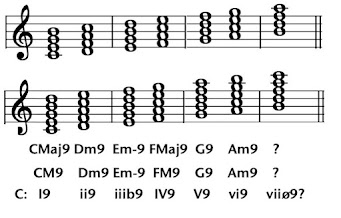
One of the graphics above showed triads and seventh chords aligned. Here is the analogous one for seventh and ninth chords. 

This looks daunting but there really are just a couple changes of any importance. The chords on C and F are still the same: Cmaj9 and Fmaj9. So are the chords on D and A: Dm9 and Am9. On the other hand, the chords on E and B have collapsed into things that are unusable—which is to say that musicians in the later 19th and early 20th centuries did their best to avoid them (or they would alter notes in them). 

The chord on G is special. It succeeds in combining a similar characteristic of G7 and Bø7, specifically, the expressive dissonance at the top of G7—the note F5 in the graphic—is added onto and intensified by another expressive dissonance at the top of G9 (the note A5). Nevertheless, the seventh and ninth are different: go back to the harmonic series above The notes at positions number 7 & 11 (marked with an asterisk) are both “out of tune,” that is, difficult to bring into harmony with other pitches in scales or intervals in any familiar tuning system. People have known this for a long time, hence, the medieval diabolus in musica (“the Devil in music”), which would apply to the tritone B4-F5 here. But notice that the ninth A5 does not sit at the top of a tritone; it belongs to the perfect fifth D5-A5 and thus renders an arguably more consonant (or well maybe less dissonant) sound in the dominant ninth chord compared to the dominant seventh chord. Musicians in the 19th century recognized this and made the most of it.

We’ve reached the dominant ninth through chordal derivations so far, but there is another way to look at it, through the major scale. In this graphic, a C major scale appears at the left, my parsing of it at the right. Of the seven pitches, the dominant ninth (above) uses up five of them, whereas the C major triad (below) has only three. The practical implication of this—not lost on 20th century musicians especially—is that the dominant ninth can easily be used to harmonize quite a few melody tones.


In the common sequence of topics, this is where I would either keep on going and introduce the last two of the so-called “extended chords”—the eleventh and thirteenth chords—or I would discuss voice-leading for the dominant ninth chord. Although I acknowledge, just like I did with the ninth chords, that stacking up the thirds makes these chords easy to spell and remember, the problem is that the “extended chord” scheme is completely wrong historically. First of all, the eleventh and thirteenth chords both derive from substitution, not from adding more thirds: the eleventh takes the place of the tenth and the thirteenth takes the place of the twelfth. Second, one almost never sees these chords in their full form with six or seven notes: two or even three notes are commonly omitted. Discussing them now, in other words, would take us far afield from our main topic, which is how we can learn some essentials of tonal harmony by starting from the dominant ninth chord.

As to voice-leading, those discussions quickly collapse back into giving priority to 17th and 18th century rules (which, to be sure, are not entirely arbitrary but are based on 17th and 18th century practices). Voice-leading doesn’t work quite the same way after about 1860 (or thereabouts), and it was the dominant ninth that led the way, fueling a different attitude toward the upper part of the major scale, or scale degrees ^5-^8, G-A-B-C in C major, and even for the prohibition on parallel fifths. 

I have written about these historical issues elsewhere in this blog and in essays published on Texas ScholarWorks: see especially "The Dominant Ninth in Music from 1900 to 1924, Part 1" and "The Dominant Ninth and Tonic Seventh in the Upper Tetrachord of the Major Key."

More on the repertoire problem in a subsequent post.