Ludwig Bussler was a student of Siegfried Dehn, whose Harmonielehre was discussed in the previous post. Bussler was born in Berlin and spent most of his life there. He published a number of textbooks, including a Praktische Harmonielehre in Aufgaben in 1865. A posthumous fifth "revised edition" edited by Hugo Leichtentritt (1903) was available to me, along with an English translation of the second edition published in 1891.
It's hard to see any particular evidence of Dehn's influence in Bussler's dominant-ninth chapter, which is indeed practical and whose explanations and strictures are in line with most textbooks in the latter half of the 19th century.
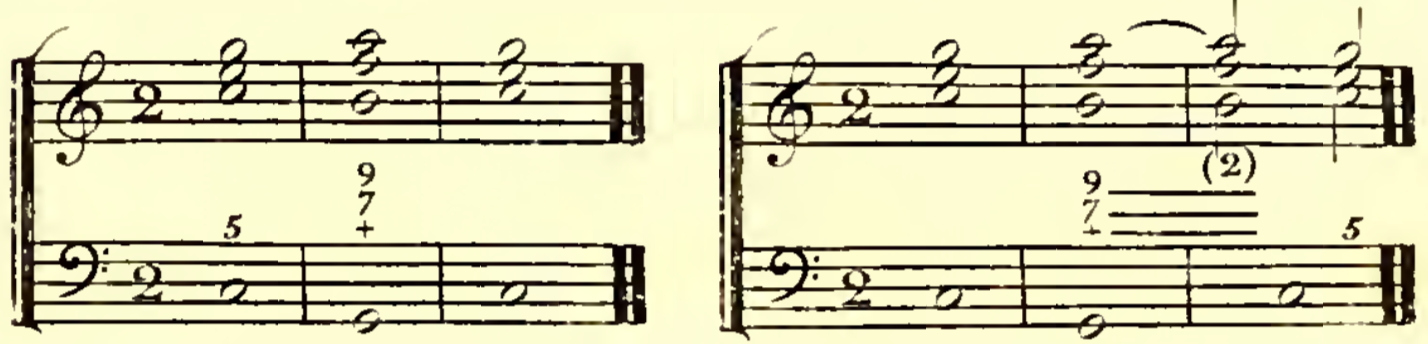
Bussler generates the ninth chord by adding the ninth above the dominant seventh. He never mentions other extended chords. The dominant ninth is among the dissonant principal chords (Hauptakkorde), along with the dominant seventh, the diminished triad, both diminished seventh chords, and the tonic 6/4. He shows the standard resolutions, with the third (D5 in the first chord below, D4 in the second) rising to avoid parallel fifths:
He admits three inversions (the examples are from the English edition, p. 41):
but rejects the fourth "for the principle of chord-formation by successive thirds would thereby be abandoned, and the chord of the ninth be stricken out of the list of chords in a limited sense" (English trans., p. 40). He adds that the interval of the ninth must never be inverted to a seventh: "It is only necessary to strike such an inverted chord to make plain the need of this rule."
Of the following example, Bussler remarks "By the aid of this chord the descending scale can now be well harmonized between the seventh and sixth degrees" (p. 41).
Finally, he says that the ninth is best when "prepared" by appearing in the immediately preceding chord. He rejects the following (even though they were quite common in music, especially music for the stage, even at the time of his book's first edition, a point which he does not mention).
Reference:
Ludwig Bussler, Praktische Harmonielehre in Aufgaben (1865).
Ludwig Bussler, Elementary Harmony (1891), translated from the second German edition. Source: Internet Archive; digital facsimile of a copy from the University of California at Berkeley.
Ludwig Bussler, Praktische Harmonielehre in Aufgaben, Part 1 of Praktische musikalische Compositionslehre, edited by Hugo Leichtentritt (1903). Source: Internet Archive; digital facsimile of a copy from the University of Toronto. The 2-volume edition (with counterpoint as the second volume) was first published in 1878-79.
Harmony and History, c1800-1950. Two-paragraph summary: see the post for 12-30-2025.
Saturday, August 10, 2019
Thursday, August 8, 2019
Fétis; Siegfried Dehn
By 1840, the dominant seventh chord was universally regarded as a basic harmony, but views about the ninth chord still varied. The most rigid models rejected as harmonies all dissonances other than the dominant seventh. For example,
Fétis was based in Brussels. During the same period, Siegfried Dehn worked in Berlin as a well-respected teacher, archivist, and editor. Dehn sought a way to include elevenths and thirteenths among the principal harmonies of a key (Hauptaccorde), a broader category than source chords (Stammaccorde), which are triads. (The dominant seventh is among the Hauptaccorde.) Dehn divides his harmony treatise in the conventional way into two parts (Capitel in the original): theoretical and practical, the first part dealing with the generation and derivation of harmonies, the second with their application to composition. The 21st of 25 chapters (§§ in the original) in Part 1 is on the ninth chord (the 22d and 23d are on the eleventh and thirteenth chords, respectively). The corresponding chapters in Part 2 are 24-26 (of 32).
As Blättler describes Dehn's method of derivation,
The important aspect of this figure is that Dehn sees no problem with a direct resolution of the major dominant ninth chord to the tonic, with its voice-leading of ^6 to ^5. This is certainly more in tune with compositional practice by 1840 than the restriction of harmonies to triads and seventh chords. He even provides a sequence with secondary dominant ninths (boxed):
Alas, when he offers a comprehensive example for all three extended chords, Dehn reverts to a chorale where those chords appear exclusively over dominant basses (boxed), effectively nullifying the ninth chord's status as an independent harmony (Dehn 1860, 219). This ambiguity and uncertainty, I note again, is typical of theoretical treatments through the century.*
* A contributing factor to the confusion is Dehn's unusual sidelining of suspensions—discussion is confined to the final chapter of Part 2, along with other non-harmonic note figures.
Reference:
Damian Blättler, "A Voicing-Centered Approach to Additive Harmony Music in France, 1889-1940," PhD dissertation, Yale University, 2013.
Siegfried Dehn, Theoretisch-praktische Harmonielehre (1840; second edition 1860). The latter was the one available to me. Its source: Digital facsimile from the Bayerische Staatsbibliothek through the Digitale Bibliothek, Münchener DigitalisierungsZentrum.
François-Joseph Fétis, Traité complet de la théorie et de la pratique de l’harmonie (1844).
François-Joseph Fetis “rejected the leading-tone seventh chord, all types of ninth chords, and the supertonic seventh chords. . . as true chords. Instead these verticalities, as are all other dissonant formations save for the dominant seventh, are explained using the concepts of substitution and/or retardation. Substitution is the replacement of the fifth scale degree in a dominant chord by the sixth scale degree, which produces both the dominant ninth chord and leading-tone seventh chords” (Blättler 2013, 56).See two examples extracted from Blättler’s Figure 1.32 below. Fétis handles inversion by expanding the common argument against the fourth inversion of the ninth chord against all inversions of the chords listed in the quote above (56-57).
Fétis was based in Brussels. During the same period, Siegfried Dehn worked in Berlin as a well-respected teacher, archivist, and editor. Dehn sought a way to include elevenths and thirteenths among the principal harmonies of a key (Hauptaccorde), a broader category than source chords (Stammaccorde), which are triads. (The dominant seventh is among the Hauptaccorde.) Dehn divides his harmony treatise in the conventional way into two parts (Capitel in the original): theoretical and practical, the first part dealing with the generation and derivation of harmonies, the second with their application to composition. The 21st of 25 chapters (§§ in the original) in Part 1 is on the ninth chord (the 22d and 23d are on the eleventh and thirteenth chords, respectively). The corresponding chapters in Part 2 are 24-26 (of 32).
As Blättler describes Dehn's method of derivation,
Ninth chords are generated . . . by placing a third both above and below the diminished triad of a key . . . ; eleventh and thirteenth chords are generated by placing the tonic note beneath the dominant seventh and ninth chords respectively. . . . These chords cannot appear in inversion nor can they sustain omissions of their roots, uppermost tones, or leading tones—restrictions [justified] on practical grounds. The extended triads cannot be inverted because their identity is dependent on a specific voicing [that is, stacks of thirds]. (p. 33)Thus, although Dehn succeeds in placing these among the Hauptaccorde, their practical application [pace his own claims] is quite limited (Blättler, 34-35). In Part 2, chapter 24 "On the treatment of ninth chords," Dehn shows only the major and minor dominant ninths, but he does include secondary dominants. The chapter is primarily concerned with voice-leading. Here is his table of proper (regelmässige) resolutions (Dehn 1860, 215):
The important aspect of this figure is that Dehn sees no problem with a direct resolution of the major dominant ninth chord to the tonic, with its voice-leading of ^6 to ^5. This is certainly more in tune with compositional practice by 1840 than the restriction of harmonies to triads and seventh chords. He even provides a sequence with secondary dominant ninths (boxed):
Alas, when he offers a comprehensive example for all three extended chords, Dehn reverts to a chorale where those chords appear exclusively over dominant basses (boxed), effectively nullifying the ninth chord's status as an independent harmony (Dehn 1860, 219). This ambiguity and uncertainty, I note again, is typical of theoretical treatments through the century.*
* A contributing factor to the confusion is Dehn's unusual sidelining of suspensions—discussion is confined to the final chapter of Part 2, along with other non-harmonic note figures.
Reference:
Damian Blättler, "A Voicing-Centered Approach to Additive Harmony Music in France, 1889-1940," PhD dissertation, Yale University, 2013.
Siegfried Dehn, Theoretisch-praktische Harmonielehre (1840; second edition 1860). The latter was the one available to me. Its source: Digital facsimile from the Bayerische Staatsbibliothek through the Digitale Bibliothek, Münchener DigitalisierungsZentrum.
François-Joseph Fétis, Traité complet de la théorie et de la pratique de l’harmonie (1844).
Tuesday, August 6, 2019
Georg Andreas Sorge, Compendium harmonicum
In the previous post, I wrote that "Sorge corrected [the problem of extended chords by sub-position] by stacking thirds above the root, though he permitted only the dominant ninth as an independent harmony (Blättler 2013, pp. 30-32)." Blättler cites the dissertation of James Martin; the first section of my notes here is mainly quotes from it; the second section quotes from David Sheldon's foundational article on Germany theories of the ninth chord.
According to Martin,
Reference:
Damian Blättler, "A Voicing-Centered Approach to Additive Harmony Music in France, 1889-1940," PhD dissertation, Yale University, 2013.
James M. Martin, “The Compendium Harmonicum (1760) of Georg Andreas Sorge: A Translation and Critical Commentary,” PhD dissertation, The Catholic University of America, 1981.
David Sheldon, “The Ninth Chord in German Theory,” Journal of Music Theory 26 (1982): 61- 100.
Georg Andreas Sorge, Compendium Harmonicum (1760). Source: The Internet Archive. Digital facsimile from The University of North Carolina.
Gottfried Weber, Versuch einer geordneten Theorie der Tonsetzkunst (1817-21).
According to Martin,
Sorge had observed that the dominant ninth chord was taken often without preparation in music, and he sought a natural source for this sonority within the overtone series. . . . With the Compendium Sorge made three important contributions to the field of musical theory regarding seventh and ninth chords: (1) he rejected the theory of supposition as a source for the ninth chord; (2) he recognized the dominant seventh and ninth chords as essential sonorities which could appear unprepared; and (3) he accepted all positions of the bass and offered numerous examples for practice and study. (p. 39)
Here is the charming opening passage of Sorge's Chapter X “On the Free and Unsuspended Ninth, and Its Derivatives” in Martin's translation: “The ninth free and unsuspended? Indeed, yes. Isn't that new? Certainly not. Nature had created it long ago, yet it just wasn’t known. . . . This free and unsuspended ninth ascends above the seventh; thus, it is found over the dominant chord in both [major and minor]. And it decorates this very harmonic structure like a beautiful gold button” (p. 204). His explanatory example has first a major dominant ninth, then a minor ninth.
Later Sorge declares that “If space permitted, I could refer to more than a thousand examples from our great composers of the past. . . . Just a single instance: look at the Duetto in the opera Angelica e Modoro, "Dimmi una volta addio" of our blessed Capellmeister Graun" (p. 205). Here is that example. Clearly Sorge means by "free and unsuspended" not an independent dominant ninth sonority in the 19th-century manner, but a ninth that is struck without the preparation that would be required of a suspension.
In every instance in the two examples above, the resolution (that is, continuation from the ninth) is what I call internal, within the dominant, not external which would be to the next chord.
David Sheldon's article on the ninth chord in 18th century German theory remains an essential resource. He describes Sorge as a "conspicuous and important figure in the history of the
ninth chord" (p. 73). In his earlier theory (that is, before the Compendium), Sorge relied on J. D. Heinichen's categorization of thorough-bass figures to explain the ninth chord as an inversion of a non-triadic chord (!), which Sheldon attributes to Sorge's determined rejection of Rameau's (and Marpurg's) theory of supposition. Once he accepts the dominant seventh chord as a fundamental entity, however, Sorge's thinking changes, leading him
Thus, we begin to move beyond the Ramellian notion of the ninth chord as derived from the dominant seventh by adding a third below the root, only to find an equally awkward removal of the root, an early presentation of a common idea in 19th century theories where the dominant ninth is accepted as a basic chord but understood to appear in practice mainly (or only) as one of the diminished seventh chords. We will see the most extreme form of this notion in Gottfried Weber's treatise.David Sheldon's article on the ninth chord in 18th century German theory remains an essential resource. He describes Sorge as a "conspicuous and important figure in the history of the
ninth chord" (p. 73). In his earlier theory (that is, before the Compendium), Sorge relied on J. D. Heinichen's categorization of thorough-bass figures to explain the ninth chord as an inversion of a non-triadic chord (!), which Sheldon attributes to Sorge's determined rejection of Rameau's (and Marpurg's) theory of supposition. Once he accepts the dominant seventh chord as a fundamental entity, however, Sorge's thinking changes, leading him
to a tentative, yet modern conception of the dominant ninth chord as a fundamental harmonic entity. It is modern in that the ninth is achieved by adding a third above the dominant seventh chord rather than below; the real fundamental bass of the ninth chord is therefore its lowest note, not its third. Sorge attempts to prove the primacy of the dominant 9 chord not only by [inverting it] but also, much more importantly, by regarding it as the basis for the seventh chords on the leading-tone degree of major and minor. Practice, rather than theory, seems to constitute the heart of Sorge's argument here. The fact that neither the ninth nor the seventh of the dominant chord need be prepared, and the fact that the dominant seventh and dominant ninth chords (or any of their inversions) can be substituted for each other can be taken as implicit proof of Sorge's claim regarding the origin of the leading-tone seventh chord. In an entirely new manner, therefore, Sorge uses the concept of a ninth chord to justify free handling of the leading-tone seventh chord. . . . Sorge's acceptance of the V9 is, nevertheless, tentative, applying only to those situations in which the ninth is freely approached. (pp. 73-74)
Reference:
Damian Blättler, "A Voicing-Centered Approach to Additive Harmony Music in France, 1889-1940," PhD dissertation, Yale University, 2013.
James M. Martin, “The Compendium Harmonicum (1760) of Georg Andreas Sorge: A Translation and Critical Commentary,” PhD dissertation, The Catholic University of America, 1981.
David Sheldon, “The Ninth Chord in German Theory,” Journal of Music Theory 26 (1982): 61- 100.
Georg Andreas Sorge, Compendium Harmonicum (1760). Source: The Internet Archive. Digital facsimile from The University of North Carolina.
Gottfried Weber, Versuch einer geordneten Theorie der Tonsetzkunst (1817-21).
Sunday, August 4, 2019
Damian Blättler on historical explanations
Damian Blättler's dissertation is concerned mainly with a theoretical model for analysis of additive harmonies in the French modernist repertoire (Debussy, Ravel, and Milhaud provide his main examples). He also gives a compact presentation of the model in an article published in Music Theory Online: link.
Chapter 1 of the dissertation is of interest here. It looks at historical attempts to account for various types of additive harmonies, including the major dominant ninth chord. The saga begins with Rameau, whose attempt at constructing a scientific theory of music produced two strong and highly influential results—(1) a reduction of the large catalogue of figured bass chord labels to the three functional categories of tonic, dominant, and subdominant, and (2) the derivation of all chords from the triad and seventh chord—and another decidedly awkward one that follows from (2): chords by sub-position (supposition), that is, tones added below the chord root. The contradiction between chordal generation and analytical usefulness reveals the central issue about additive harmonies—first among them, the dominant ninth—that will persist throughout the 19th century (and, indeed, in textbooks well into the 20th century): "two different derivations of the same chords [expose] a tension in additive harmonic theorizing between, on the one hand, generating modified chord types by using a structural principle consistent with that used to generate the system’s basic chord types, and on the other, having a chord’s identity be defined by how it behaves in context" (2013, p. 19).
Rameau did not permit inversions of additive harmonies but later theorists influenced by him, notably Marpurg, did, in the process stacking thirds and "inventing" the eleventh and thirteenth chords (p. 28). Marpurg only compounded the problem, however, by stacking thirds below the root. His contemporary (and critic) Sorge corrected this by stacking thirds above the root, though he permitted only the dominant ninth as an independent harmony (pp. 30-32). Combined with Kirnberger's distinction between essential (or independent) and non-essential (linearly derived) harmonies, Sorge's method dominated 19th century theory textbooks and treatises, first among them Catel's Traité d'harmonie (see the previous post in this blog) (p. 32).
Thus, we encounter two of the "three distinct strategies for explaining simultaneities that are not triads or seventh chords: adapting basic chord types, identifying non-chord elements, and formulating new basic chord types' (p. 12). The last is a 20th century preoccupation that does not concern us here. Blättler, for the repertoire he studies, is especially concerned with the voicing of chords, which 19th century theorists are inconsistent about: a particular problem with the "extended-triad model is that it inadequately addresses the crucial impact voicing has on the identity of additive chords" (p. 8). Note, for example, that Catel says the fourth inversion of the dominant ninth may not be used because "it is necessary that the ninth above the root be maintained" but he doesn't say why that is the case.
As a final note, here again is Catel's figure introducing the major dominant ninth. The first might be regarded as an essential harmony (Sorge does so), while the latter is linearly derived. It is easy to see why musicians around 1800 would think it is a given that elevenths, thirteenths, and other complex formations would be "non-essential," but equally easy to see why they might equivocate about the dominant ninth.
Reference:
Damian Blättler, "A Voicing-Centered Approach to Additive Harmony Music in France, 1889-1940," PhD dissertation, Yale University, 2013.
Damian Blättler, "A Voicing-Based Model for Additive Harmony, "Music Theory Online 23/3 (2017).
Chapter 1 of the dissertation is of interest here. It looks at historical attempts to account for various types of additive harmonies, including the major dominant ninth chord. The saga begins with Rameau, whose attempt at constructing a scientific theory of music produced two strong and highly influential results—(1) a reduction of the large catalogue of figured bass chord labels to the three functional categories of tonic, dominant, and subdominant, and (2) the derivation of all chords from the triad and seventh chord—and another decidedly awkward one that follows from (2): chords by sub-position (supposition), that is, tones added below the chord root. The contradiction between chordal generation and analytical usefulness reveals the central issue about additive harmonies—first among them, the dominant ninth—that will persist throughout the 19th century (and, indeed, in textbooks well into the 20th century): "two different derivations of the same chords [expose] a tension in additive harmonic theorizing between, on the one hand, generating modified chord types by using a structural principle consistent with that used to generate the system’s basic chord types, and on the other, having a chord’s identity be defined by how it behaves in context" (2013, p. 19).
Rameau did not permit inversions of additive harmonies but later theorists influenced by him, notably Marpurg, did, in the process stacking thirds and "inventing" the eleventh and thirteenth chords (p. 28). Marpurg only compounded the problem, however, by stacking thirds below the root. His contemporary (and critic) Sorge corrected this by stacking thirds above the root, though he permitted only the dominant ninth as an independent harmony (pp. 30-32). Combined with Kirnberger's distinction between essential (or independent) and non-essential (linearly derived) harmonies, Sorge's method dominated 19th century theory textbooks and treatises, first among them Catel's Traité d'harmonie (see the previous post in this blog) (p. 32).
Thus, we encounter two of the "three distinct strategies for explaining simultaneities that are not triads or seventh chords: adapting basic chord types, identifying non-chord elements, and formulating new basic chord types' (p. 12). The last is a 20th century preoccupation that does not concern us here. Blättler, for the repertoire he studies, is especially concerned with the voicing of chords, which 19th century theorists are inconsistent about: a particular problem with the "extended-triad model is that it inadequately addresses the crucial impact voicing has on the identity of additive chords" (p. 8). Note, for example, that Catel says the fourth inversion of the dominant ninth may not be used because "it is necessary that the ninth above the root be maintained" but he doesn't say why that is the case.
As a final note, here again is Catel's figure introducing the major dominant ninth. The first might be regarded as an essential harmony (Sorge does so), while the latter is linearly derived. It is easy to see why musicians around 1800 would think it is a given that elevenths, thirteenths, and other complex formations would be "non-essential," but equally easy to see why they might equivocate about the dominant ninth.
Reference:
Damian Blättler, "A Voicing-Centered Approach to Additive Harmony Music in France, 1889-1940," PhD dissertation, Yale University, 2013.
Damian Blättler, "A Voicing-Based Model for Additive Harmony, "Music Theory Online 23/3 (2017).
Saturday, August 3, 2019
Catel, Traité d'harmonie (1802)
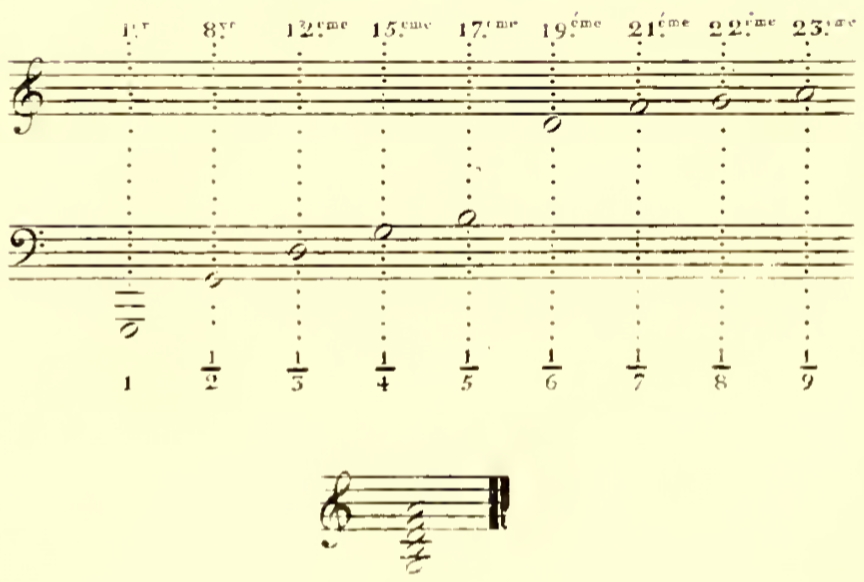
Charles-Simon Catel wrote a very efficient harmony textbook (70 pages in its first edition) that was adopted by the recently founded Paris Conservatoire.* It contains no speculative theory, but Catel does invoke the harmonic series to generate his list of eight basic chords ("all chords that are practical for harmony"; p. 7). He does this in two stages, starting from the fourth harmonic (note that he is using the dominant of C major, not the tonic) (p. 6):
. . . then starting from the fifth harmonic and ignoring "intermediate tones" (p. 7):
Here are the eight chords (they are in vertical format in the Traité; I have rearranged them in horizontal format):
Catel then gives one chapter (article) to each of the eight. For the dominant ninth, he shows both direct and internal resolutions (my terms, not his) (p. 17):
He permits inversions of the ninth chord, but not the fourth inversion because "it is necessary that the ninth above the root be maintained") (p. 17; the examples below are from p. 18, put into horizontal format here).
Despite this promising beginning, the dominant ninth plays almost no role in the remainder of the treatise. It does appear in a long list of chordal suspensions (which Catel calls "prolongation") in chapter 7 "Notes de Passage: Prolongations, Suspensions, Retardement," where the "harmonie simple" (at the left below) is subjected to prolongation of the "chord of the leading tone over the dominant, or the dominant ninth" (p. 29) (at the right below).
The dominant ninth does not appear in subsequent chapters on suspensions and sequences, pedal points, scale genres, altered chords, and modulation.
*Note: Blättler 2013, 56n81: "The harmony texts used at the Paris Conservatoire through 1941 are, in chronological order by their years of use: Charles-Simon Catel, Traité d’harmonie, 1802-1816; Antoine Reicha, Cours de composition musicale, 1816-1851; Augustin Savard, Cours complet d’harmonie theorique et pratique, 1851-1862; Henri Reber, Traité d’harmonie, 1862-1889; Theodore Dubois, Notes et Etudes (supplement to Reber’s text), 1889-1921; Theodore Dubois, Traité d’harmonie, 1921-1950. (Rieder, 16)."
Reference:
Charles-Simon Catel, Traité d’harmonie (Paris, 1802). Digital facsimile published on the Internet Archive. Source: University of North Carolina at Chapel Hill. Note: An edition from 1874 shows no changes in text or examples for the dominant ninth. Source: Bibliothèque nationale de France at gallica.bnf.fr.
Mildred Freeman Rieder, “Traité d’harmonie by Theodore Dubois in the Context of 19th-Century French Harmonic Theory and Pedagogy,” MM thesis, The University of Western Ontario, 1995.
. . . then starting from the fifth harmonic and ignoring "intermediate tones" (p. 7):
Here are the eight chords (they are in vertical format in the Traité; I have rearranged them in horizontal format):
Catel then gives one chapter (article) to each of the eight. For the dominant ninth, he shows both direct and internal resolutions (my terms, not his) (p. 17):
He permits inversions of the ninth chord, but not the fourth inversion because "it is necessary that the ninth above the root be maintained") (p. 17; the examples below are from p. 18, put into horizontal format here).
Despite this promising beginning, the dominant ninth plays almost no role in the remainder of the treatise. It does appear in a long list of chordal suspensions (which Catel calls "prolongation") in chapter 7 "Notes de Passage: Prolongations, Suspensions, Retardement," where the "harmonie simple" (at the left below) is subjected to prolongation of the "chord of the leading tone over the dominant, or the dominant ninth" (p. 29) (at the right below).
The dominant ninth does not appear in subsequent chapters on suspensions and sequences, pedal points, scale genres, altered chords, and modulation.
*Note: Blättler 2013, 56n81: "The harmony texts used at the Paris Conservatoire through 1941 are, in chronological order by their years of use: Charles-Simon Catel, Traité d’harmonie, 1802-1816; Antoine Reicha, Cours de composition musicale, 1816-1851; Augustin Savard, Cours complet d’harmonie theorique et pratique, 1851-1862; Henri Reber, Traité d’harmonie, 1862-1889; Theodore Dubois, Notes et Etudes (supplement to Reber’s text), 1889-1921; Theodore Dubois, Traité d’harmonie, 1921-1950. (Rieder, 16)."
Reference:
Charles-Simon Catel, Traité d’harmonie (Paris, 1802). Digital facsimile published on the Internet Archive. Source: University of North Carolina at Chapel Hill. Note: An edition from 1874 shows no changes in text or examples for the dominant ninth. Source: Bibliothèque nationale de France at gallica.bnf.fr.
Mildred Freeman Rieder, “Traité d’harmonie by Theodore Dubois in the Context of 19th-Century French Harmonic Theory and Pedagogy,” MM thesis, The University of Western Ontario, 1995.
Tuesday, July 23, 2019
new publication
I have published an essay Dominant Ninth Harmonies in American Songs around 1900 on the Texas ScholarWorks platform: link.
Here is the abstract:
Among many changes in creative practices in music during the nineteenth century was the freer treatment of the ninth above the dominant, including independent V9 harmonies. This essay discusses songs composed, performed, and published in the United States from roughly 1890 to 1920. Composers include, among others, Beach, Hageman, Herbert, MacDowell, Nevin, Rogers, and Sousa.Here is the table of contents:
Introduction
Amy (Mrs. H. H. A.) Beach
“Sweetheart, sigh no more!” (1891)
“The Summer Wind” (1891)
“The Thrush” (1891)
“Far awa’!” (1899)
“Forget-Me-Not” (1897)
“Good Morning” (1902)
“Juni” [June] (1903)
Edward MacDowell
“Long ago, sweetheart mine,” op. 56n1 (1898)
“Constancy,” op. 58n1 (1899)
“Tyrant Love,” op. 60n2 (1902)
Rupert Hughes, ed., Songs by Thirty Americans (1904)
James H. Rogers, “April Weather” (1899)
Harry Rowe Shelley, “The Ride” (1904)
Nathaniel Hyatt, “The Spring of Love” (1900)
Rubin Goldmark, “The Passionate Shepherd to His Love” (1904) Anthology of American Songs: A Collection of Twenty-Six Songs by Representative American Composers (1911)
James H. Rogers, “At Parting” (1886)
Harry Rowe Shelley, “Love’s Sorrow” (1888)
Ethelbert Nevin, “Serenade” (1884)
C. Whitney Coombs, “Her Rose” (1905)
Henry Hadley, “Rose-Time” (1910)
Victor Harris, “April” (1908)
Albert A. Mack, “Forever and a Day” (1903)
Richard Hageman, “At the Well” (1919)
Appendix
Monday, February 11, 2019
Administrative
In the introductory post to this blog, I wrote that in studying cadence figures in the upper tetrachord of the scale, "I noticed the variety of treatments of scale degree ^6 as the ninth of a dominant ninth chord. This blog is intended to document some of those, especially in the essential 19th century European repertoires of the musical stage and music for dance." Link to the introduction.
A subsequent post looked more closely at the different melodic and harmonic treatments of the dominant ninth: link to "On seven types of the dominant ninth."
I also announced publication of an essay, Dominant Ninth Harmonies in the 19th Century: link to the post. Link to the essay on Texas ScholarWorks. This is intended as a gallery of simple (clear) examples from the repertoire.
A subsequent post looked more closely at the different melodic and harmonic treatments of the dominant ninth: link to "On seven types of the dominant ninth."
I also announced publication of an essay, Dominant Ninth Harmonies in the 19th Century: link to the post. Link to the essay on Texas ScholarWorks. This is intended as a gallery of simple (clear) examples from the repertoire.
Monday, February 4, 2019
Benjamin, Horwitz, Koozin, and Nelson
When I retired three years ago, I gave away almost all of my library, including textbook copies, and am now living in an area where I don't have easy access. That is by way of explanation for no more than a modest internet search, which pulled up just one textbook table of contents detailed enough to list examples. That TOC is for the excerpt anthology to one of the standard texts used in college-level two-year music theory sequences: Music for Analysis: Examples from the Common Practice Period and the Twentieth Century, 8th edition, by Thomas Benjamin, Michael Horvit, Timothy Koozin, and Robert Nelson (2018).
Here are their examples of the dominant ninth chord (the titles are lightly edited for clarity and completeness):
326. J. STRAUSS, Künstlerleben (Artist's Life) Waltzes, op. 316, no. 3
327. FRANCK, Sonata for Violin and Piano, first movement
328. BEETHOVEN, Six Easy Variations, WoO 77, theme
329. CHOPIN, Grand Valse Brillante in Ab major, op. 34, no. 1
330. SCHUMANN, Liederkreis, op. 39, no. 3: "Waldesgespräch"
331. CHOPIN, Prelude in Db major, op. 28, no. 15 "Raindrop"
Secondary Dominant Ninths
332. BACH, St. Matthew Passion, no. 78: final chorus "Wir setzen uns mit Tränen nieder"
333. SCHUMANN, Genoveva, op. 81: Overture
334. GRIEG, Lyrical Pieces, vol. 9: "Grandmother's Minuet," op. 68, no. 2
335. SCHUMANN, Kinderszenen, op. 15, no. 7: "Träumerei"
Comment on each of these below. As a reminder, here are the categories I have developed for the different uses of the dominant ninth:
1. Internal resolution (within the V chord)
1.0. Element of melodic shape (step)
1.1. Element of melodic shape (leap, off the beat)
1.2. Element of chord, weak beat
1.3. Element of chord, strong beat
2. External resolution (to the following chord, usually I)
2.1. Indirect resolution to ^5
2.2. Indirect resolution to ^6
2.3. Direct resolution to ^5 or ^6
To each of the book's examples:
326. J. STRAUSS
332. BACH
Here are their examples of the dominant ninth chord (the titles are lightly edited for clarity and completeness):
326. J. STRAUSS, Künstlerleben (Artist's Life) Waltzes, op. 316, no. 3
327. FRANCK, Sonata for Violin and Piano, first movement
328. BEETHOVEN, Six Easy Variations, WoO 77, theme
329. CHOPIN, Grand Valse Brillante in Ab major, op. 34, no. 1
330. SCHUMANN, Liederkreis, op. 39, no. 3: "Waldesgespräch"
331. CHOPIN, Prelude in Db major, op. 28, no. 15 "Raindrop"
Secondary Dominant Ninths
332. BACH, St. Matthew Passion, no. 78: final chorus "Wir setzen uns mit Tränen nieder"
333. SCHUMANN, Genoveva, op. 81: Overture
334. GRIEG, Lyrical Pieces, vol. 9: "Grandmother's Minuet," op. 68, no. 2
335. SCHUMANN, Kinderszenen, op. 15, no. 7: "Träumerei"
Comment on each of these below. As a reminder, here are the categories I have developed for the different uses of the dominant ninth:
1. Internal resolution (within the V chord)
1.0. Element of melodic shape (step)
1.1. Element of melodic shape (leap, off the beat)
1.2. Element of chord, weak beat
1.3. Element of chord, strong beat
2. External resolution (to the following chord, usually I)
2.1. Indirect resolution to ^5
2.2. Indirect resolution to ^6
2.3. Direct resolution to ^5 or ^6
To each of the book's examples:
326. J. STRAUSS
I have written about this waltz set on my Ascending Cadence Gestures blog: link. In the first instance the chord is inverted (the bass shifts the chord back and forth between second and first inversion), category 2.2. In the second instance it is a "waltz ninth" in the cadence—that is, ^6 moves upward to ^7—and fits category 1.3.327. FRANCK
One of the most striking cases of an extended (prolonged) dominant ninth before 1900. I will post a separate study of it at a later date.328. BEETHOVEN
The ninth chord (beginning the theme's B section) is an incidental result of parallel tenths moving against a dominant pedal tone. Category 1.0.329. CHOPIN, op. 34, no. 1
In the introduction, category 1.3 (an element of an extended dominant chord). In the second strain (bars 33 ff.), direct resolution, category 2.3.330. SCHUMANN, "Waldesgespräch"
In the piano introduction, direction resolution of the ninth with expressive repetition on the strong beat. Category 2.3.331. CHOPIN, "Raindrop" Prelude
Category 1.2 (element of the chord, weak beat emphasis) in the cadences of the exposition and reprise (more prominently in the latter). The appearance of ^6 in bar 3 is category 1.0, a melodic element coincidentally arising from parallel 6ths. This figure is marked enough (repeated) that one could very likely develop a reading based on it as a key to interpretation, an "odd" moment that is developed motivically and harmonically—but I am not concerned with that kind of work in this blog.Secondary Dominant Ninths
332. BACH
In the introduction and in the chorus's opening phrases. I assume this was included because it allows an easy comparison of the chords with minor ninth and major ninth. Category 1.0.333. SCHUMANN, Overture
Here again, perhaps the choice is the comparison between minor and major ninths, the former very dramatic at the beginning, the latter appearing more than once in the major key area that follows (which I presume is the subordinate key area of a sonata form exposition)334. GRIEG
Clear example of V9 of V at the very beginning (bar 1). Category 2.3.335. SCHUMANN, "Träumerei"
Category 1.1 in bar 3; category 1.2 strictly speaking in bar 22, though I would like to call it 1.3 because of the special emphasis of the fermata; possibly the same in the final bar because of the octave leap down from ^6 (D5) over ii to ^6 (D4) as ninth of V.Note: These are my own comments on the examples. I did not have access to the textbook itself, only the list of examples.
Tuesday, January 29, 2019
MacDowell, To a Water Lily
Edward MacDowell, "To a Water Lily" from the Woodland Sketches, op. 51 (1895). Like "To a Wild Rose," this is a simple ternary design—and with a prominent role for a dominant ninth harmony in both A and B sections.
The main theme:
Below is the second part of the B section, as in "To a Wild Rose" an expansion of the dominant, though this time with the pedal bass tone literally sounded. In the midst of this, the V9 chord appears here and there, but the beginning and ending sonorities are the dominant seventh (V7).
In the cadence, the dominant ninth harmony is given considerable attention -- boxed -- and functions as the cadential dominant -- see bar 3.
The main theme:
Below is the second part of the B section, as in "To a Wild Rose" an expansion of the dominant, though this time with the pedal bass tone literally sounded. In the midst of this, the V9 chord appears here and there, but the beginning and ending sonorities are the dominant seventh (V7).
In the cadence, the dominant ninth harmony is given considerable attention -- boxed -- and functions as the cadential dominant -- see bar 3.
Monday, January 28, 2019
MacDowell, To a Wild Rose
Edward MacDowell, "To a Wild Rose" from the Woodland Sketches, op. 51 (1895). I have published an essay, with many details about this piece, on the Texas Scholarworks platform: link.
One aspect of "simplicity" in the main theme is the blocking of the chordal accompaniment, which adds a sort of untutored—I am tempted to say "Grandma Moses"—quality to the whole. The system below the theme score reduces the voiceleading to its textbook or classroom version, and there one can see more easily the V9 harmonies. An interesting point about bar 4: a plausible and rare second inversion of the dominant ninth chord (I write about inversions of the "extended" chords in the Gallery essay). In the cadence, we are obliged to imagine the E4 to which the ninth F#4 would resolve, but it's a very easy one in this context.
The design of "To a Wild Rose" is a simple ternary form; the relatively brief B-section is shown below.
Here again a voiceleading reduction is useful, including the addition of an obvious implied dominant pedal point (one is grateful to MacDowell's artistic sense not to ask for this literally).
In the ending, both V9/V and the cadential V9 are no longer present. Instead, we have the more traditional viiø7/V (understood by theorists of the time as the V9 without its root—a bizarre idea if we think about it now, but it made sense at the time, as everyone was attempting to adjust the system of figured bass to the new Ramellian (that's Rameau's) scheme of fundamental bass and three functions, tonic, dominant, and subdominant). Here, MacDowell makes out of the circled chord a wonderfully expressive highpoint, pianissimo.
One aspect of "simplicity" in the main theme is the blocking of the chordal accompaniment, which adds a sort of untutored—I am tempted to say "Grandma Moses"—quality to the whole. The system below the theme score reduces the voiceleading to its textbook or classroom version, and there one can see more easily the V9 harmonies. An interesting point about bar 4: a plausible and rare second inversion of the dominant ninth chord (I write about inversions of the "extended" chords in the Gallery essay). In the cadence, we are obliged to imagine the E4 to which the ninth F#4 would resolve, but it's a very easy one in this context.
The design of "To a Wild Rose" is a simple ternary form; the relatively brief B-section is shown below.
Here again a voiceleading reduction is useful, including the addition of an obvious implied dominant pedal point (one is grateful to MacDowell's artistic sense not to ask for this literally).
In the ending, both V9/V and the cadential V9 are no longer present. Instead, we have the more traditional viiø7/V (understood by theorists of the time as the V9 without its root—a bizarre idea if we think about it now, but it made sense at the time, as everyone was attempting to adjust the system of figured bass to the new Ramellian (that's Rameau's) scheme of fundamental bass and three functions, tonic, dominant, and subdominant). Here, MacDowell makes out of the circled chord a wonderfully expressive highpoint, pianissimo.
Monday, January 21, 2019
Schubert again
Here are several more examples of dominant ninth harmonies in Schubert, mostly from Laendler but also one from the song cycle Die schöne Müllerin.
D734n5:
D790n12:
D366n17:
D734n16:
D783n2:
Die schöne Müllerin, n12 "Pause":
D734n5:
D790n12:
D366n17:
D734n16:
D783n2:
Die schöne Müllerin, n12 "Pause":
Subscribe to:
Posts (Atom)